SEBI’s HVDLE / Debt-Listing Compliance Streamlining: What the Consultation Direction Suggests
SEBI’s HVDLE consultation suggests a more proportionate debt-listing compliance framework. Debt issuers, NBFCs, company secretaries, and CFO teams should watch what simplification may mean in practice.
- hvdle
- debt listing compliance
- sebi lodr
- listed debt
- nbfc compliance
- corporate governance
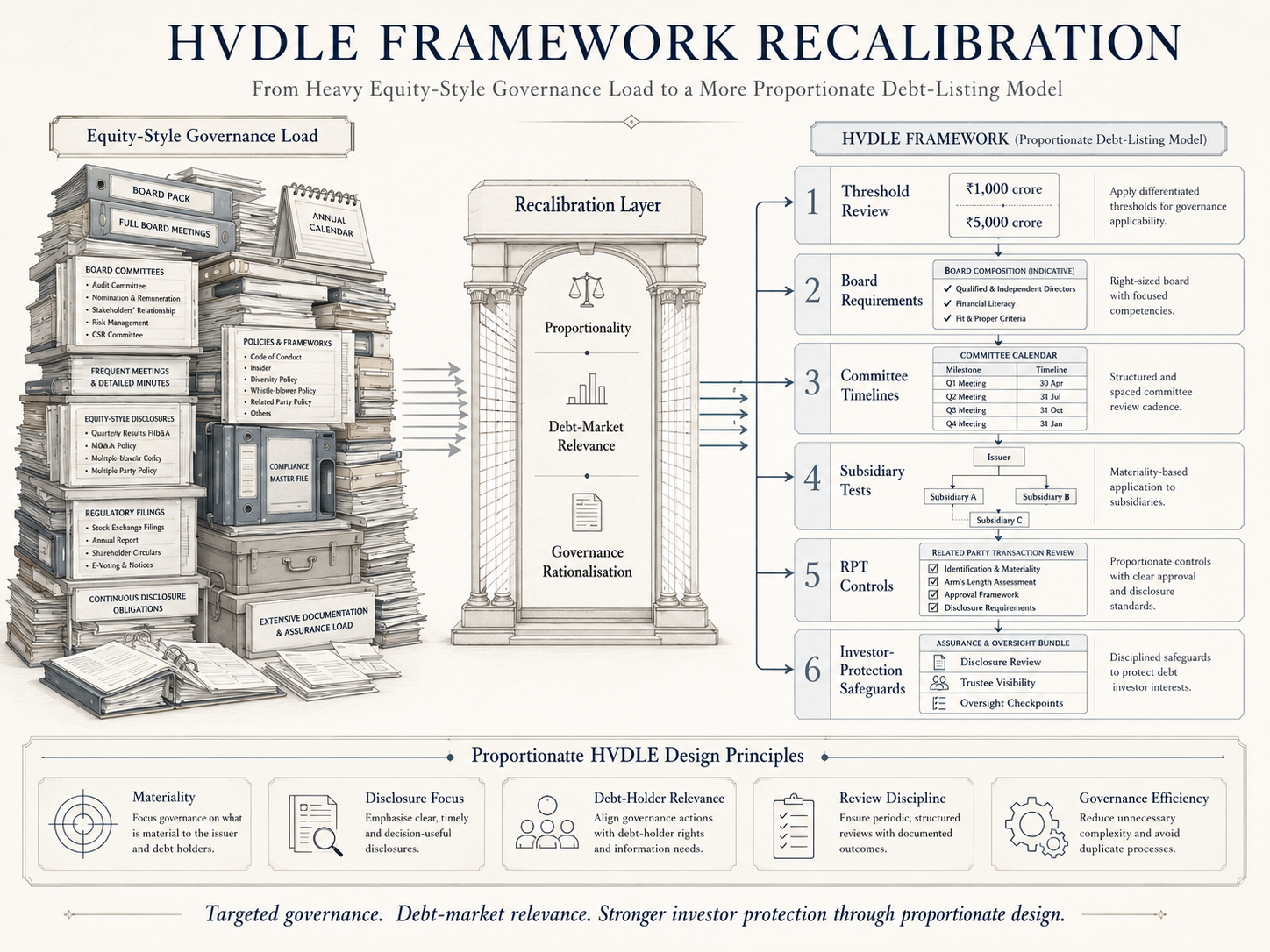
Debt-listed entities have been living with a practical question for some time: should a company that has listed high-value debt be treated, for governance purposes, almost like an equity-listed company?
SEBI’s latest HVDLE consultation suggests that the answer may be moving towards something more balanced.
The consultation paper issued in October 2025 does not remove the need for governance. It does not say debt investors need no protection. It does not suggest that entities raising large sums through listed non-convertible debt securities should operate without discipline.
What it does suggest is a more proportionate approach.
That distinction matters.
High Value Debt Listed Entities, or HVDLEs, occupy an unusual space. They may not have listed equity. Their investor base may be largely institutional. Their debt issuances may be part of normal treasury operations, especially for NBFCs and financial-sector issuers. Yet once they cross the regulatory threshold, they face a governance and disclosure framework that can feel close to the equity-listed regime.
For some issuers, this may be justified. For others, especially those repeatedly raising debt in private placements, the compliance load can become heavy without necessarily improving investor protection in the same proportion.
This is the core tension the consultation appears to recognise.
The first major signal is threshold recalibration.
The proposal to raise the HVDLE identification threshold from ₹1,000 crore to ₹5,000 crore is not only a number change. It is a policy signal. SEBI appears to be asking whether the current threshold captures too many entities that are not truly systemically significant enough to justify the full HVDLE governance burden.
For NBFCs and debt-heavy issuers, this matters because debt raising is not always an exceptional corporate event. It may be a regular funding activity. A threshold that is too low can pull routine debt issuers into a high-compliance category sooner than intended.
If the threshold is increased, some entities may fall outside the HVDLE net. But compliance teams should be careful. A consultation is not an exemption. Until final amendments are notified and effective, entities should continue to track their present obligations.
The practical action is to build a threshold file.
Debt-listed entities should know their outstanding listed non-convertible debt securities, the date of measurement, the instruments included, the group or entity-level position where relevant, and whether they may remain within or exit HVDLE classification if the proposal becomes final.
The second signal is board and committee simplification.
HVDLE governance has been difficult because it imports a formal board-and-committee discipline into entities that may not have originally structured themselves like equity-listed companies. Board composition, independent director availability, committee vacancies, shareholder approval timelines, and age-related director requirements can all create implementation pressure.
Streamlining here could reduce unnecessary friction. But it should not be misunderstood as a reduction in board responsibility.
For issuers that remain HVDLEs, the board will still need a clear governance calendar. Audit committee, nomination and remuneration committee, stakeholder relationship committee, risk management committee, and board-level approvals may still require monitoring. The difference may be in timelines, alignment, and practical flexibility.
That means simplification should lead to better compliance, not casual compliance.
The third signal is subsidiary-related alignment.
Debt-listed groups often have subsidiaries that matter commercially, financially, or operationally. The consultation direction around subsidiary thresholds and terminology suggests an attempt to align HVDLE requirements more closely with the equity-listed framework where appropriate.
This is important because subsidiary tests can create confusion. Is materiality based on income, turnover, net worth, or another measure? Does the subsidiary transaction require approval? Does the listed debt issuer need to monitor subsidiary-level governance even where the debt investors are protected through debenture trustee oversight?
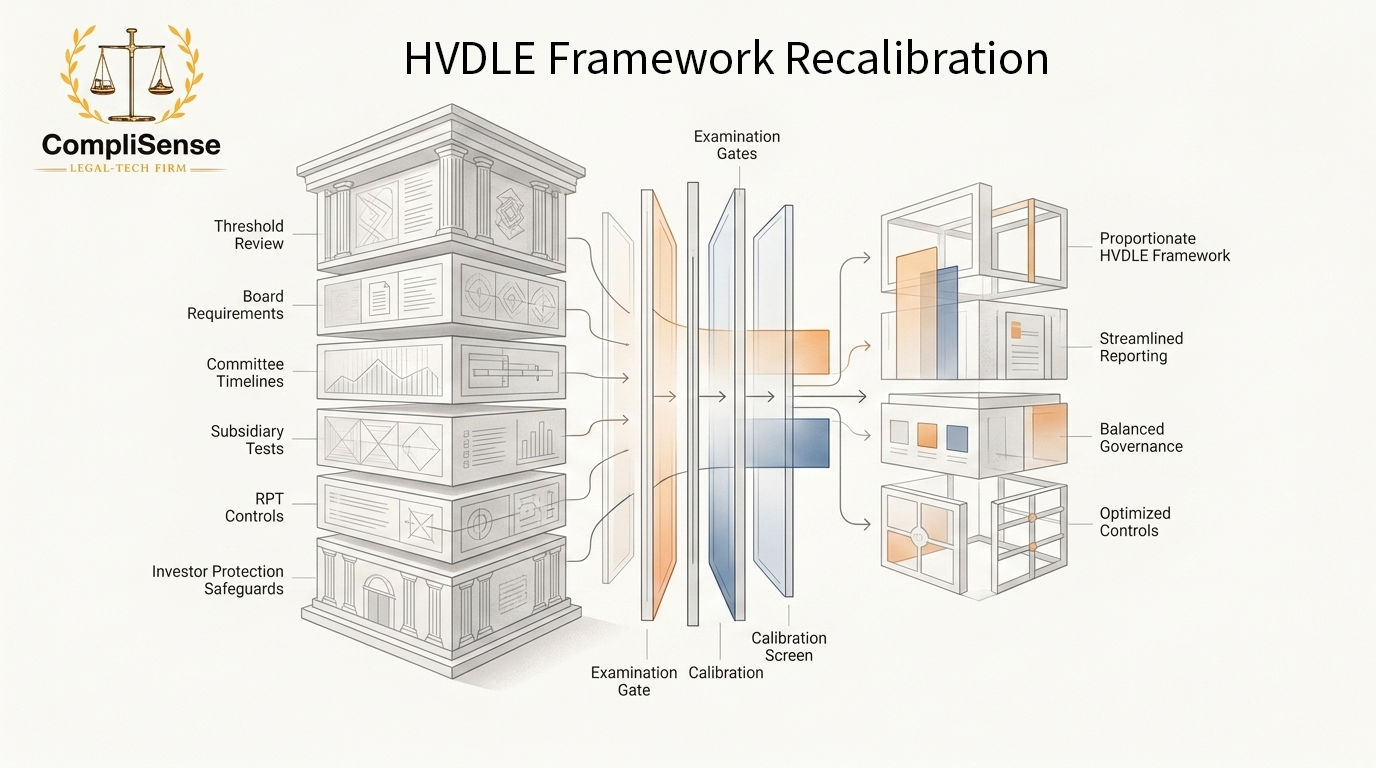
These questions are not academic. They affect board papers, subsidiary reporting, finance team data pulls, group-structure records, and secretarial calendars.
Companies should use this consultation period to clean their subsidiary mapping. Which subsidiaries are material under current rules? Which may be material under revised terminology? Which transactions or asset movements require review? Which teams provide subsidiary data to the listed entity?
The fourth signal is RPT streamlining.
Related party transactions are a recurring pain point for debt-listed entities because the governance logic is sensitive. On one side, debt investors need protection against value leakage, conflict transactions, and group-level risk shifting. On the other side, institutional debt investors, debenture trustees, covenants, and security structures already create some protective layers.
SEBI’s consultation direction seems to recognise that RPT compliance for HVDLEs may need calibration rather than duplication.
For compliance teams, the practical question is not whether RPT review will disappear. It will not. The question is whether the approval and disclosure route becomes more proportionate.
Companies should therefore prepare in three ways.
First, maintain a clean related-party master. Second, preserve rationale and pricing support for material transactions. Third, track whether debenture trustee involvement, NOC requirements, audit committee review, secretarial audit, or periodic reporting obligations apply.
If simplification comes, firms with clean RPT records will benefit most. Firms with messy transaction mapping will still struggle.
The fifth signal is that debt-listing compliance may become more risk-based.
This is the larger direction. SEBI appears to be balancing two objectives: reduce unnecessary compliance load for entities that do not require full equity-like governance treatment, while preserving investor safeguards for truly high-value or systemically relevant debt issuers.
That is a sensible direction for the debt market. A compliance framework should not discourage legitimate debt raising merely because the procedural burden becomes disproportionate. At the same time, the debt market cannot grow on weak governance, poor disclosures, or hidden related-party risk.
The entities that should watch this consultation closely include NBFCs with frequent NCD issuances, private companies or public companies with listed debt but no listed equity, large corporate issuers, treasury teams, company secretaries, CFO offices, debenture trustees, and debt-market investors.
For them, the consultation is not just a legal update. It is a planning trigger.
Issuers should ask:
Will we remain an HVDLE if the threshold changes?
Which governance obligations would still apply?
Which board or committee requirements may be relaxed or aligned?
Which subsidiary tests need recalculation?
Which RPT processes may shift?
Which disclosures or reports can be simplified?
Which controls must remain because investors and trustees still expect them?
This is how companies should read the consultation: not as permission to stop tracking, but as an opportunity to redesign tracking around what actually matters.
Compliance simplification in practice should mean fewer redundant filings, clearer applicability, better-aligned timelines, reduced duplication, and more focused governance. It should not mean weaker documentation, weaker committee records, or weaker transaction discipline.
That is the key point.
When regulators streamline, good companies use the relief to improve the quality of the remaining controls. Weak companies use it to relax too far.
Debt-listed entities should avoid the second mistake.
The practical preparation checklist is straightforward:
Calculate current and proposed HVDLE status.
Review board and committee gaps.
Map subsidiary thresholds.
Clean the RPT register.
Identify filings that may change if proposals become final.
Track final SEBI amendments separately from the consultation note.
Update the compliance calendar only after the final rule position is clear.
Preserve the basis for any change in applicability.
For HVDLEs and debt-listed issuers, the consultation direction is encouraging. It points towards a more workable, proportionate framework. But the transition will still require discipline.
Simplification does not remove compliance work. It changes what compliance teams must focus on.
Related compliance hubs
Continue from this explainer into topic hubs that connect analysis with regulator updates and workflow context.
Related regulator archives
Continue into source-linked archives for regulators connected to this topic area.
Related articles
Continue with related analysis selected by the editorial team or sharing the same topics.
Related legal updates
Source-linked updates that place this article in the current regulatory workflow.
Content accountability
Prepared by CompliSense Editorial Desk (Regulatory Content Team) and reviewed by CompliSense Regulatory Review Desk (Compliance Review Team).
This attribution reflects the preparation and review roles used for CompliSense regulatory publishing.