Related Party Transactions Are Tightening Again: What Listed Entities Should Prepare For
SEBI’s August 2025 RPT consultation may ease some thresholds, but it raises the bar for internal discipline. Listed entities need better party mapping, approval packs, disclosures, and documentation quality.
- related party transactions
- rpt compliance
- sebi lodr
- listed entities
- audit committee approval
- shareholder approval
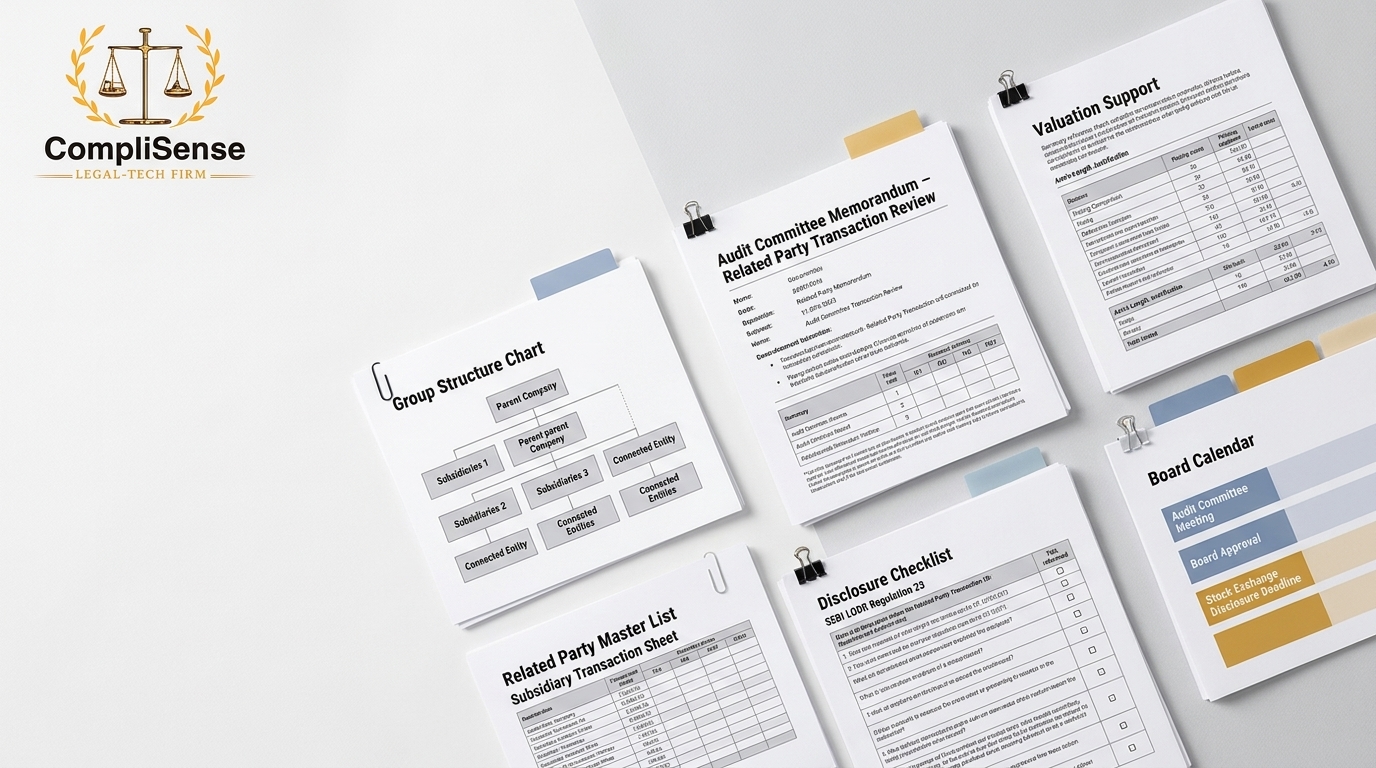
The next RPT mistake will probably not begin inside an audit committee meeting.
It will begin earlier.
A vendor will be onboarded without being mapped properly. A subsidiary transaction will sit with finance but not reach secretarial in time. A recurring transaction will cross an approval threshold quietly. A disclosure pack will be prepared from old information. Someone will say, “This is routine,” but nobody will have the documents to prove why.
That is where listed entities should focus after SEBI’s August 2025 consultation on related party transactions.
SEBI published its consultation paper on August 4, 2025, proposing amendments to provisions relating to RPTs under the SEBI LODR Regulations and circulars thereunder. Mondaq also described the consultation as a significant proposed overhaul of the RPT regime, covering materiality thresholds, subsidiary transactions, disclosures, omnibus approvals, and applicability clarifications.
The headline may sound like relaxation in some areas. SEBI proposed scale-based materiality thresholds linked to annual consolidated turnover, replacing the existing “₹1,000 crore or 10% of turnover, whichever is lower” approach for determining material RPTs.
But listed entities should not misunderstand the practical effect.
When thresholds, exemptions, disclosure levels, and subsidiary tests change, the internal process becomes more important, not less. The company must know which transactions need approval, which need reduced information, which still need full disclosure, which can be exempted, and which must be escalated because of subsidiary-level impact.
That cannot be handled through last-minute emails.
The first preparation area is the related-party master.
Many companies maintain a list of related parties, but the quality varies. Some lists are legal-heavy but not operational. Some are finance-led but miss relatives, promoter-linked entities, or group changes. Some are updated annually but not when management, shareholding, subsidiaries, or control relationships change.
That is risky.
RPT compliance depends on clean identity data. Who is a related party? Which entities are linked to promoters, directors, KMPs, subsidiaries, joint ventures, or associates? Which counterparties appear repeatedly in procurement, leasing, services, loans, guarantees, brand arrangements, or shared services?
If the master list is weak, the transaction review will also be weak.
The second preparation area is approval routing.
RPTs should not reach the audit committee as a surprise. The business team should know when a proposed transaction needs compliance review. Finance should know when values are aggregating during the year. Secretarial should know which approvals are required before execution. Legal should know when contracts need arm’s-length support or conflict checks.
The process should answer three questions before a transaction moves:
Is the counterparty a related party?
Is the transaction covered under the RPT framework?
What approval or disclosure route applies?
SEBI’s consultation also addressed subsidiary-level RPTs. For transactions where an unlisted subsidiary is a party and the listed entity is not, SEBI discussed thresholds based on the lower of 10% of the subsidiary’s standalone turnover or the material RPT threshold of the listed entity, with specific treatment for transactions above ₹1 crore.
This is where listed entities often face friction.
Subsidiaries may run their own finance and contracting processes. They may treat a transaction as local or routine. But from the listed parent’s governance perspective, the transaction may still require audit committee attention. If subsidiary teams do not report early, the listed entity may discover the issue after the commercial process has already advanced.
So the parent company needs a subsidiary RPT reporting protocol. Not a vague instruction. A working process.
Every subsidiary should know what must be reported, when it must be reported, who must review it, and what documents must support it. The parent should also track aggregation during the financial year, because a transaction that looks small alone may matter when combined with previous transactions.
The third preparation area is disclosure quality.
SEBI’s June 26, 2025 circular prescribed industry standards on the minimum information to be provided to the audit committee and shareholders for approval of RPTs. The later consultation discussed relaxation in the minimum information requirements for certain RPTs above ₹1 crore but below the lower of 1% of annual consolidated turnover or ₹10 crore.
This creates a practical challenge: companies must classify the disclosure pack correctly.
Not every transaction will need the same level of detail. But that does not mean weak documentation is acceptable. Even a lighter information requirement must be accurate, consistent, and supported.
For each RPT approval pack, teams should preserve the basics:
Name of related party.
Nature of relationship.
Transaction value and tenure.
Commercial rationale.
Pricing or arm’s-length basis.
Whether the transaction is recurring.
Whether it forms part of an omnibus approval.
Whether previous transactions with the same party affect thresholds.
Whether subsidiary-level approvals are triggered.
What evidence supports management’s recommendation.
The fourth preparation area is audit committee readiness.
Audit committees do not need data dumps. They need clean decision material. If the note is vague, the committee cannot properly evaluate conflict, fairness, business rationale, financial exposure, or shareholder impact.
A good RPT note should explain why the transaction exists, why the related party is involved, how pricing was assessed, whether comparable alternatives exist, whether the transaction is recurring, whether it is in the ordinary course, and whether it is at arm’s length.
The fifth preparation area is omnibus approval discipline.
SEBI’s materials discuss bringing provisions on the validity of shareholder omnibus approvals into Regulation 23(4), including validity up to the next AGM for AGM approvals, not exceeding fifteen months, and not exceeding one year for approvals obtained in other general meetings.
This matters because omnibus approvals can create false comfort.
An omnibus approval is not a blank cheque. The company still needs to monitor actual transactions against the approved scope, value, tenure, party, and conditions. If the transaction changes materially, or if values exceed what was approved, the approval process should be revisited.
The sixth preparation area is applicability judgment.
SEBI’s consultation also dealt with clarifications around applicability of RPT provisions, including retail purchases involving directors, KMPs, and their relatives where terms are uniformly applicable.
This is a reminder that RPT compliance is not only threshold arithmetic. It also requires judgment.
Teams must distinguish between genuine routine transactions and transactions that carry governance risk. They must also document why a transaction is exempt, why it is not treated as an RPT, or why a lighter route applies. Silence is not a defence. A short decision note is better than a blank checkbox.
The preparation checklist for listed entities is clear:
Clean the related-party master.
Map subsidiary reporting lines.
Track transaction aggregation during the year.
Separate full-disclosure and lighter-disclosure cases.
Prepare better audit committee notes.
Monitor omnibus approvals against actual usage.
Preserve pricing support, rationale, and approval evidence.
Record why a transaction was exempted or routed in a particular way.
The real tightening is not only in the text of the regulation. It is in the quality of internal coordination expected from listed entities.
RPT compliance sits between finance, legal, secretarial, business teams, subsidiaries, audit committee members, and sometimes shareholders. If these teams do not share the same transaction view, errors become likely.
The companies that handle this well will not wait for the final approval stage. They will build an RPT pipeline: identify, classify, aggregate, document, approve, disclose, and monitor.
That is the level of discipline listed entities should prepare for.
Related compliance hubs
Continue from this explainer into topic hubs that connect analysis with regulator updates and workflow context.
Related regulator archives
Continue into source-linked archives for regulators connected to this topic area.
Related articles
Continue with related analysis selected by the editorial team or sharing the same topics.
Related legal updates
Source-linked updates that place this article in the current regulatory workflow.
Content accountability
Prepared by CompliSense Editorial Desk (Regulatory Content Team) and reviewed by CompliSense Regulatory Review Desk (Compliance Review Team).
This attribution reflects the preparation and review roles used for CompliSense regulatory publishing.