How to Track Late-Night Circulars Without Missing Morning Implementation
A circular released after business hours can affect operations the next morning. The answer is not simply faster monitoring—it is a regulatory-intelligence process that converts updates into owned, actionable implementation.
- regulatory updates
- compliance monitoring
- sebi
- stock exchanges
- depositories
- regulatory change management
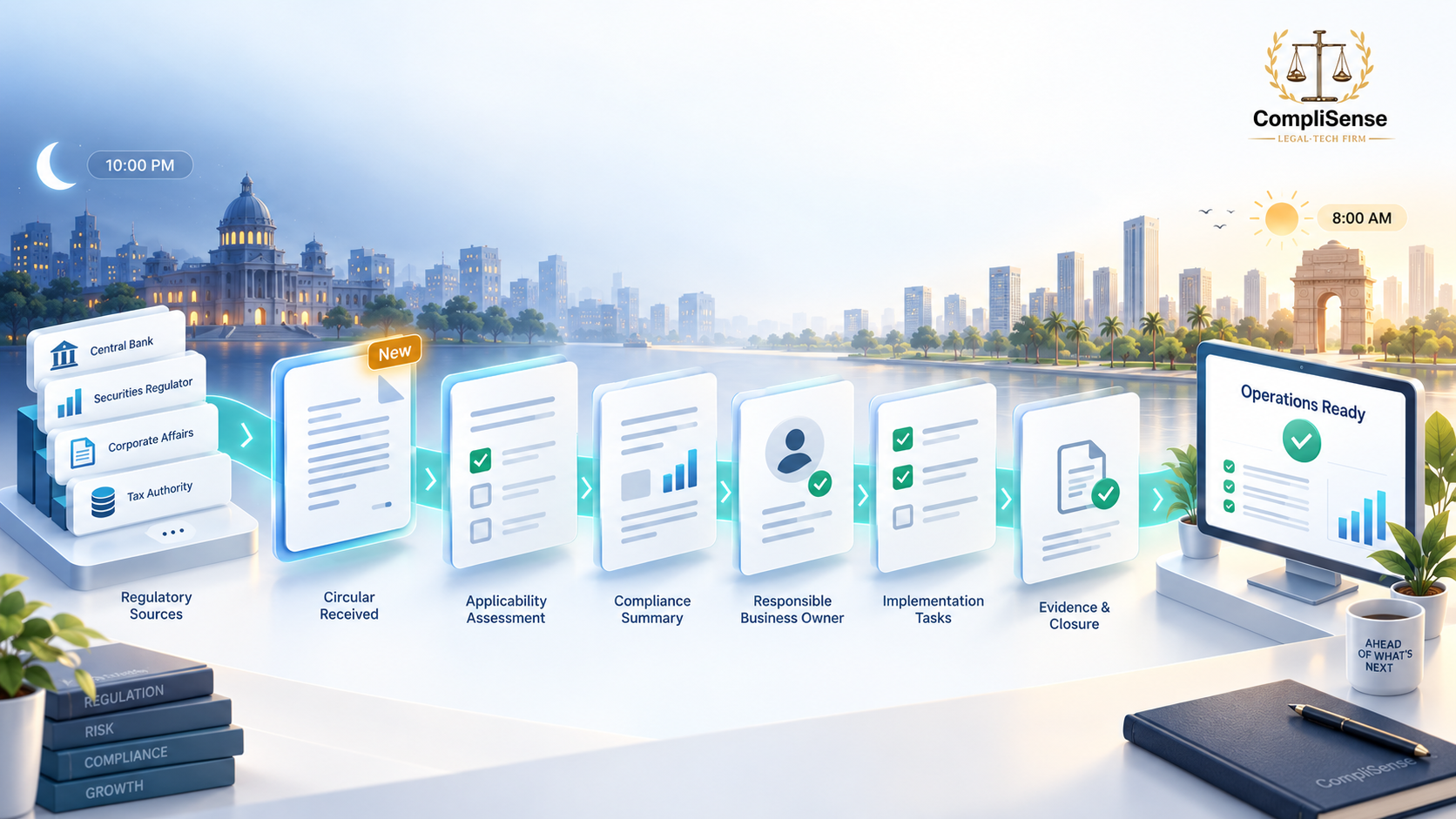
A regulatory circular does not become less important because it arrives after the Compliance team has left the office. For market intermediaries, the difficult updates are often not the ones with a six-month implementation period. They are the circulars, exchange notices, depository communiqués and operational instructions that appear late in the day but influence what Operations, Technology, Risk, dealing teams or client-facing functions need to do the next morning.
This creates a different compliance problem from ordinary regulatory research. Finding the circular is only the first step. The real challenge is moving from publication to interpretation, applicability, ownership and action quickly enough that the business is not discovering the change after operations have already begun.
1. Regulatory Monitoring Cannot End at 6 P.M.
Many organisations still structure regulatory monitoring around conventional working hours. Compliance teams review regulator websites during the day, circulate important changes, and pick up anything else the following morning. That may work for longer-horizon policy changes, but it becomes increasingly fragile in markets where exchanges, depositories, clearing corporations and regulators regularly issue operational communications throughout the day.
The danger is not simply “missing a circular”. The bigger risk is losing the implementation window. A notice published late in the evening may change a trading parameter, operating process, reporting requirement, system availability, client communication or action expected from participants. If the first person to identify the circular is an Operations employee after logging in the next morning, Compliance has already become reactive.
Late-day monitoring therefore needs to be treated as an operational control rather than an optional research activity.
2. Speed Without Applicability Creates Noise
The obvious solution appears to be faster alerts. Monitor every website continuously, scrape everything and send every newly published document immediately.
That usually creates a second problem: alert fatigue.
A market intermediary may technically receive hundreds of regulatory documents, circulars, clarifications, notices, press releases and operational communications across its regulatory universe. Most employees should not receive all of them. A stock-broking Operations team does not need every circular relevant to mutual funds, and a Depository Participant should not have to manually determine whether every exchange notice affects it.
A useful regulatory-intelligence process therefore needs to make three decisions rapidly:
What changed? Is it applicable to us? Who needs to know or act?
The difference between regulatory monitoring and regulatory intelligence is this layer of interpretation. The objective is not to deliver the largest number of updates fastest. It is to ensure that the right update reaches the right person with enough context to act.
3. Every Important Update Needs an Initial Operational Classification
Not every late-night circular requires someone to start work immediately. Compliance needs a way to distinguish urgency.
A practical first-pass classification could separate updates into:
- Immediate / next-business-day impact — operational, system, trading or participant instructions requiring near-term action.
- Implementation required — a new requirement with a future effective date that needs process or system changes.
- Compliance-calendar impact — filing, reporting, audit or certification obligations.
- Review / policy impact — changes requiring Legal, Compliance or management interpretation but no immediate operating change.
- Information only / not applicable — recorded for completeness without generating unnecessary action.
The important point is that classification should happen when the update is processed, not several days later during a weekly circular review.
A late-night update with a future effective date may not require an emergency message, but it should still enter the organisation’s regulatory-change workflow immediately so that implementation time is not lost.
4. Morning Implementation Requires More Than a Summary
A five-line summary is useful, but it does not automatically produce compliance. Imagine that a circular changes a process effective the next business day. Compliance sends an accurate summary at 9 P.M. The Operations team reads it at 9:15 the following morning but does not know whether a system configuration has already changed, whether an SOP needs revision or who is responsible for confirming implementation.
The organisation has successfully delivered information, but not necessarily managed the obligation.
For operationally significant updates, the communication should ideally identify four things:
Change → Applicability → Required action → Owner
Where the answer is not immediately clear, Compliance should at least flag that an applicability or implementation assessment is required and identify who must perform it. The regulatory-update process should create accountability rather than simply forwarding the source document.
5. Build a Night-to-Morning Handover
The strongest process is not one in which Compliance Officers remain awake indefinitely watching regulatory websites. It is one in which monitoring, escalation and handover are designed deliberately. For material late-day updates, the handover should make it possible for the morning team to see, in one place:
- what was published after the normal business-day review;
- which items were assessed as applicable;
- which require action that morning;
- which business or control function owns the next step; and
- whether any clarification or management decision remains pending.
This creates continuity between the evening monitoring cycle and the next morning’s operations. It also eliminates one of the most common weaknesses in regulatory monitoring: the dependence on one person remembering what arrived the previous evening.
6. Do Not Confuse “Circulated” With “Implemented”
Compliance teams often maintain excellent evidence that a circular was circulated internally. There is an email, distribution list and timestamp proving that the organisation received and shared the update. That is useful evidence of awareness. It is not evidence of implementation. For material changes, the regulatory trail should continue:
Circular received → summary prepared → applicability confirmed → action assigned → process/system changed → evidence attached → reviewer confirms closure
That evidence may be an updated SOP, screenshot of a changed system parameter, revised client communication, completed filing, Technology ticket, approval record or another artefact appropriate to the requirement. This distinction is particularly important where the circular becomes relevant during an inspection months later. The regulator is unlikely to be interested only in whether the email reached the Operations team. The real question will be what the institution did because of it.
7. Automation Helps, but Judgment Still Matters
Technology can materially improve the first half of this process. Regulatory websites can be monitored, documents collected and updates organised by regulator, intermediary type, subject and date. Teams can avoid repeatedly visiting dozens of sources and comparing pages manually. But regulatory change management cannot be reduced completely to document collection. Applicability, materiality and implementation consequences still require contextual judgment.
This is where a platform such as CompliSense becomes useful: the goal is not merely to collect regulatory circulars, but to move from regulatory update → interpretation → applicable entity → responsible person → due date → evidence → review and closure.
For late-night circulars in particular, the value is not simply receiving an alert faster. It is shortening the distance between the publication of the regulatory change and the organisation knowing what it needs to do about it.
8. The Standard Should Be Morning Readiness
A mature regulatory-monitoring framework should be judged by a simple test. If an important regulatory communication is published after normal working hours, can the organisation begin the next business day knowing:
what changed, whether it applies, who owns it and whether anything must happen before normal operations continue?
If the answer depends on one Compliance Officer checking websites early in the morning, searching through email subscriptions or remembering an update seen the previous night, the process remains fragile. Late-night circulars are not really a monitoring problem. They are a regulatory-change operating-model problem. The objective is not to read every circular at night. It is to ensure that when the business opens the next morning, the important ones have already become actionable compliance work.
Related compliance hubs
Continue from this explainer into topic hubs that connect analysis with regulator updates and workflow context.
Related regulator archives
Continue into source-linked archives for regulators connected to this topic area.
Related articles
Continue with related analysis selected by the editorial team or sharing the same topics.
Related legal updates
Source-linked updates that place this article in the current regulatory workflow.
Content accountability
Prepared by CompliSense Editorial Desk (Regulatory Content Team) and reviewed by CompliSense Regulatory Review Desk (Compliance Review Team).
This attribution reflects the preparation and review roles used for CompliSense regulatory publishing.