How to Create a Single Source of Truth for Regulatory Updates
Regulatory monitoring breaks down when updates are scattered across WhatsApp, emails, folders, and spreadsheets. A real single source of truth brings updates, ownership, status, and evidence into one controlled system that teams can rely on consistently.
- single source of truth
- regulatory updates
- compliance operations
- regulatory monitoring
- compliance workflow
- audit trail
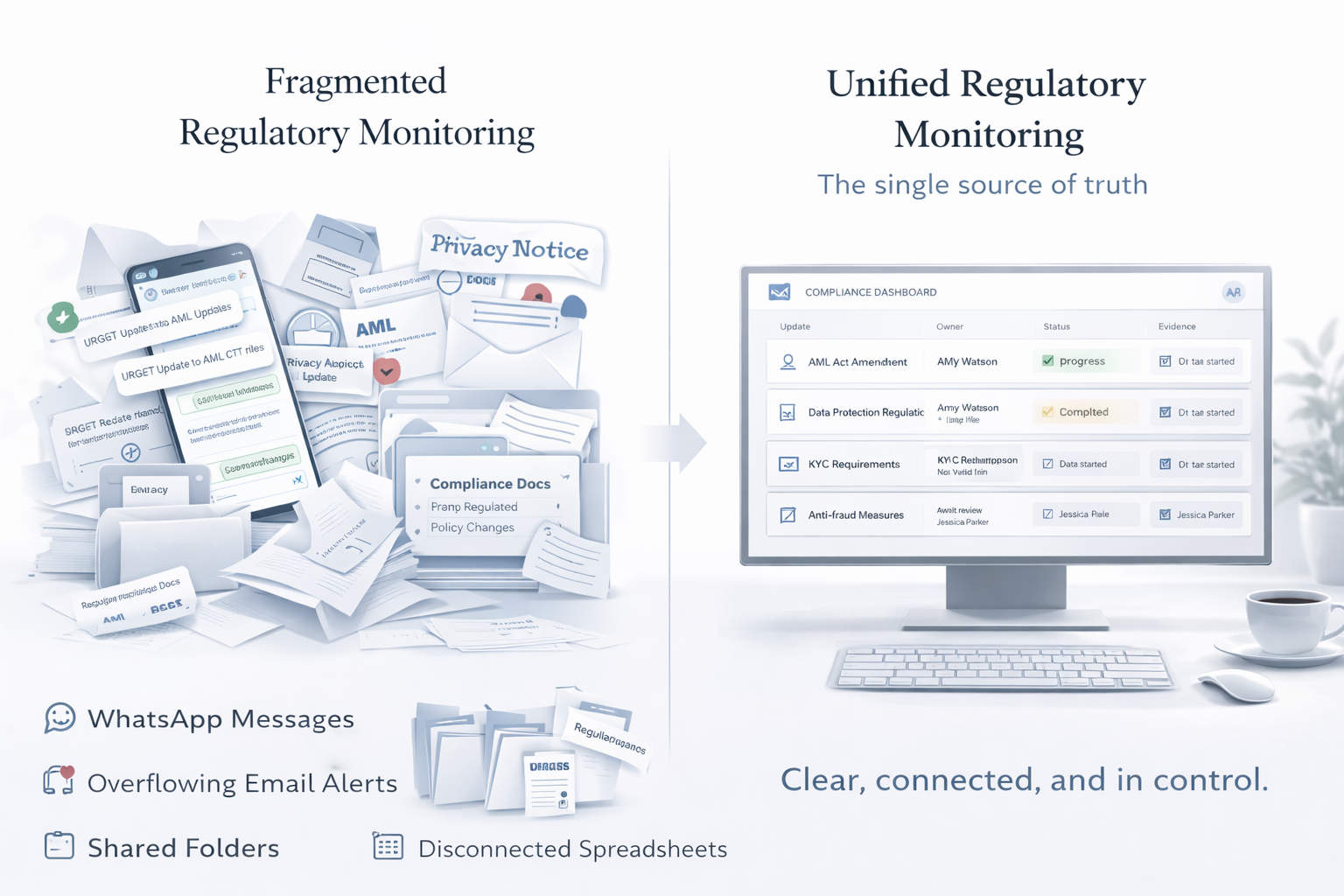
Most firms do not deliberately choose a messy regulatory monitoring process. It usually happens by accumulation.
One update comes on email. Another is dropped into a WhatsApp group because it looks urgent. Someone saves a PDF in a shared folder. Someone else tracks a few items in Excel. A senior person keeps important notes in their own mailbox. Another team maintains a separate spreadsheet for implementation. Over time, this patchwork starts looking like a process.
It is not a process. It is fragmentation that has not failed loudly yet.
That is the real problem. A scattered setup can appear workable for a long time, especially if the team is experienced and hardworking. People know where to look, at least most of the time. They remember what matters. They chase each other when something seems pending. They compensate manually for a weak system. But that only works until volume grows, people change roles, an important item slips, or supervision becomes harder.
That is when the absence of a single source of truth starts costing the firm.
The first problem with fragmented monitoring is that different people start working from different versions of reality. The compliance team may believe an update is under review because it was discussed on email. Operations may assume it was already dealt with because someone mentioned it on WhatsApp. Legal may be waiting for clarity that sits in a spreadsheet they do not regularly check. Management may think the issue is closed because a document was saved in a folder. When information lives in multiple places, teams stop sharing one operational picture. They share fragments.
The second problem is that ownership becomes unclear. Fragmented systems are good at spreading awareness and bad at fixing accountability. An item may be visible in three places and still belong to nobody in a real sense. A WhatsApp message can create urgency, but not structured assignment. An email forward can create visibility, but not controlled follow-through. A spreadsheet can show a status, but not always the real person responsible for moving the task. Once ownership becomes informal, updates can sit in the dangerous zone between “everyone saw it” and “no one truly owns it.”
The third problem is continuity risk. In many firms, a large part of regulatory memory sits inside specific individuals. One person knows which sources matter most. Another remembers why a circular was marked not applicable. Someone else knows where the evidence was saved. That may feel manageable day to day, but it is fragile. Leave, absence, role change, or simple overload can expose how much of the process depends on personal memory rather than institutional structure. A real compliance process should survive individual movement. A fragmented one often does not.
The fourth problem is weak supervision. Leaders cannot supervise well when the underlying information is scattered. They may receive updates from the team, but those updates are often reconstructed manually. That means management sees a version of the process, not the process itself. If a compliance head wants to know what came in, what applies, what is pending, what is overdue, and where evidence sits, the answers should not require pulling data from five places and asking three people. Once that happens, the firm no longer has real visibility. It has a reporting ritual.
The fifth problem is poor defensibility. This becomes painful during audits, inspections, internal reviews, or escalations. When an important question is raised, teams should be able to retrieve a clean record quickly. What was the update? When was it captured? Who reviewed it? What applicability decision was taken? Who implemented it? Where is the evidence? Fragmented systems make these answers slow and unreliable. The information may exist somewhere, but “somewhere” is not good enough when scrutiny begins.
That is why firms need a single source of truth for regulatory updates.
A single source of truth does not mean one more place where circulars are copied. It means one controlled system that becomes the firm’s authoritative operational record for regulatory monitoring and follow-through.
At a minimum, that system should capture the source of the update, the regulator or issuing authority, the date and time captured, a useful summary, the applicability decision, the owner, the due date, the status, and the evidence linked to closure. That is the foundation. Without these fields, the system becomes another viewing layer instead of a real control layer.
It should also support one consistent workflow. Updates should enter the same environment, be reviewed in the same environment, be assigned in the same environment, and be tracked in the same environment. That does not mean teams stop communicating by email or chat. It means those channels stop acting as the system of record. Communication can happen in many places. Control should not.
A proper single source of truth should also make applicability and ownership explicit. These are the two points where many firms lose control. Not every update applies to every business. And not every reviewed item automatically turns into action unless someone owns it. The system should force clarity on both. What is the decision? Who is responsible? What is the timeline? That clarity is what turns monitoring into execution.
Searchable history is another essential part of a real source of truth. Teams should be able to retrieve past updates by regulator, date, topic, owner, status, or applicability. This is not just a convenience feature. It is critical for continuity and supervision. It helps new team members understand past decisions. It helps managers spot patterns and delays. It helps firms answer repeat questions without reconstructing history each time.
Most importantly, a single source of truth strengthens continuity. It reduces dependence on memory, side conversations, and private workarounds. It allows the firm to function with more consistency even as people, workload, and regulatory volume change. That matters because strong compliance operations are not built only for normal days. They are built to remain reliable when the environment becomes more demanding.
This is the shift firms need to make. WhatsApp is not a source of truth. Email is not a source of truth. Shared folders are not a source of truth. Disconnected spreadsheets are definitely not a source of truth. They may all play supporting roles in communication or storage, but none of them should be the place the firm depends on to understand its true regulatory position.
That place should be one structured, supervised, searchable system that the whole team trusts.
Because in compliance, the real question is not whether information exists somewhere. The real question is whether the firm has one place where it can reliably see what came in, what matters, who owns it, what is pending, and what proof exists.
That is what a single source of truth is supposed to solve.
Related compliance hubs
Continue from this explainer into topic hubs that connect analysis with regulator updates and workflow context.
Related regulator archives
Continue into source-linked archives for regulators connected to this topic area.
Relevant CompliSense capabilities
These capabilities support the operating pattern discussed in this article.
Related articles
Continue with related analysis selected by the editorial team or sharing the same topics.
Related legal updates
Source-linked updates that place this article in the current regulatory workflow.
Content accountability
Prepared by CompliSense Editorial Desk (Regulatory Content Team).
This attribution reflects the preparation role used for CompliSense regulatory publishing.