One Year of Regulatory Monitoring Lessons: What Still Breaks Inside Compliance Teams
Even alert compliance teams still miss execution. After a year of monitoring regulatory updates, the same failures keep appearing: weak interpretation, unclear ownership, poor follow-up, and missing evidence.
- regulatory monitoring
- compliance operations
- legal updates
- compliance failures
- stock broker compliance
- compliance workflow
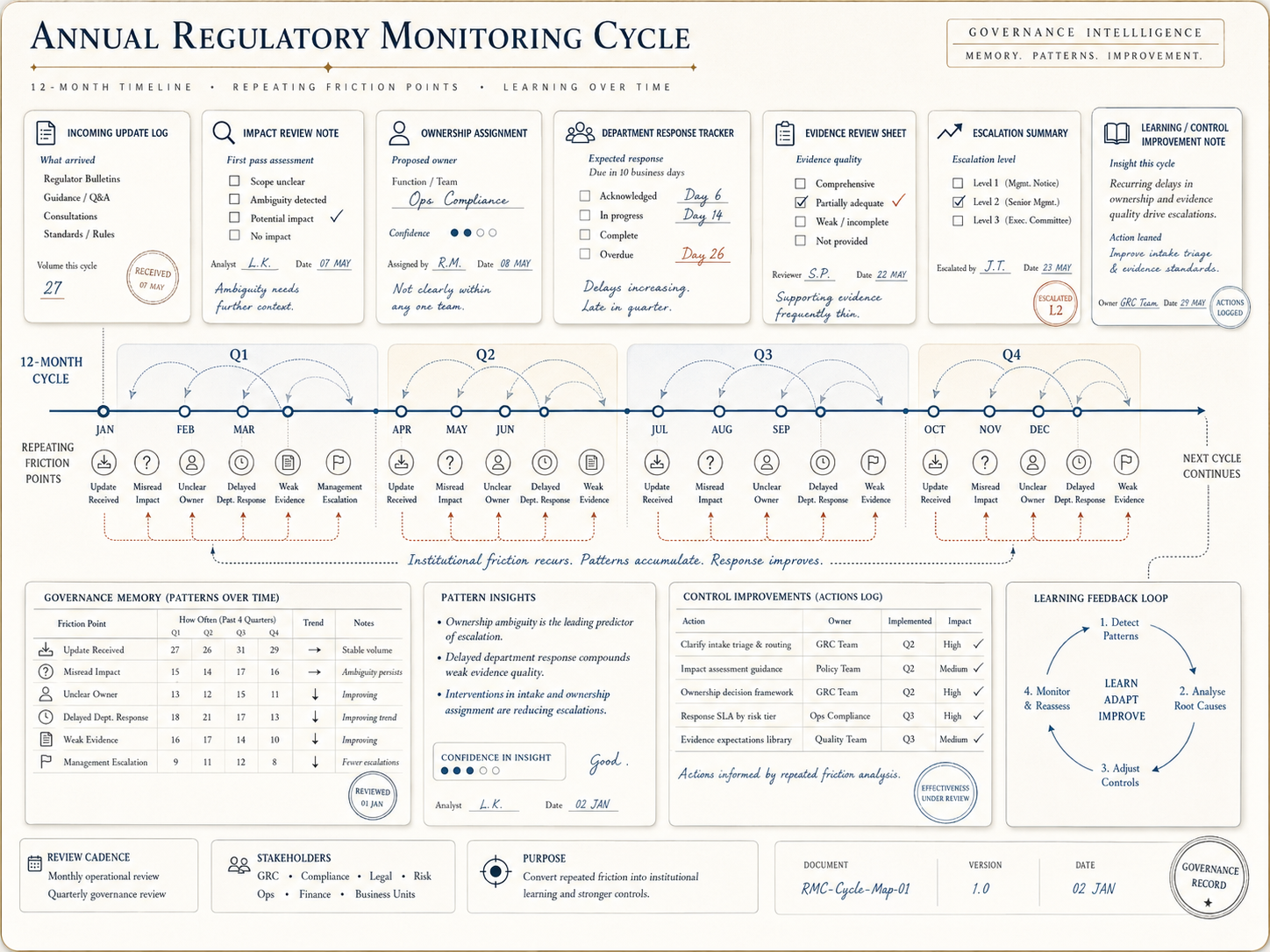
After a year of serious regulatory monitoring, most compliance teams become more alert.
They check regulator websites more often. They watch exchange circulars more carefully. They forward updates faster. They build WhatsApp groups, email lists, Excel trackers, and internal routines. They become better at noticing that something has changed.
And still, things break.
That is the uncomfortable lesson.
The biggest weakness inside compliance teams is usually not awareness anymore. It is conversion. The update is seen, but not converted into a clear decision. It is forwarded, but not converted into ownership. It is discussed, but not converted into evidence. It is remembered, but not converted into institutional record.
Regulatory monitoring does not fail only when a circular is missed. It also fails when a circular is seen but not properly operationalised.
The first recurring failure is the weak first read.
Many teams read the circular for subject matter, not impact. They understand what the regulator has issued, but not what the firm has to do next. The update is summarised as “SEBI circular on reporting” or “Exchange notice on process change.” That may be technically correct, but it is not useful.
The first read should answer a practical question: what changes for us?
Does it affect a report, a system, a client process, a deadline, a policy, a board note, a vendor, a department, or a control? If the answer is unclear, the update should not be marked as reviewed. It should be marked as requiring interpretation.
A vague first read creates weak downstream action.
The second failure is treating applicability as a checkbox.
“Applicable” and “not applicable” are not enough. The firm needs to know why. Over the past year, this is one of the most common operational gaps: teams make the correct conclusion but fail to record the reasoning.
That creates repeat work. The same question comes back from operations, management, audit, or a new team member. Compliance has to explain again why the update matters or why it does not.
A short applicability note prevents this. It turns judgment into a reusable record.
The third failure is forwarding without ownership.
This is the classic compliance illusion. The update has been sent to the relevant team, so everyone feels movement has happened. But forwarding is not assignment.
A circular may go to IT, RMS, operations, DP, accounts, legal, or finance. Unless one person or role owns the action, the update remains in circulation. People may read it. People may agree it is important. People may even discuss it. But nobody is responsible for closing it.
In compliance work, “shared responsibility” often becomes “shared delay.”
The fourth failure is late discovery of system impact.
Many regulatory updates look like compliance updates on the surface but become technology tasks in practice. A reporting field changes. A validation rule changes. A client communication template changes. A freeze, block, upload, alert, approval, or audit log becomes necessary.
If IT is involved only after compliance has spent days interpreting the circular, the timeline is already damaged.
Good monitoring should identify system impact early. The first review should ask: can this be implemented without system or vendor support?
If not, IT or the vendor should enter the conversation immediately.
The fifth failure is management escalation without a decision request.
Senior management is often copied on important updates. But too many escalations are just information dumps. The email says the circular is important, attaches a PDF, and asks everyone to “take note.”
That is not useful escalation.
Management should be told what decision or support is needed. Is budget required? Is a vendor delay blocking implementation? Is a department not responding? Is there client impact? Is a board-level note needed? Is there deadline risk?
Escalation should reduce uncertainty, not spread it upward.
The sixth failure is closure without proof.
This is where many teams hurt themselves. A department says the task is done. Compliance marks it closed. Later, during audit or review, the evidence is missing, incomplete, or stored in someone’s inbox.
A closure without evidence is only a claim.
The evidence does not need to be complicated. It may be a filing acknowledgement, screenshot, revised SOP, approval note, client communication copy, system change record, vendor confirmation, training record, or meeting note. But it must exist, and it must be linked to the update.
The seventh failure is not learning from repeat questions.
Over a year, the same questions keep returning.
“Does this apply to us?”
“Who handled the previous circular?”
“What did we do last time?”
“Where is the exchange reference?”
“Was this already implemented?”
“Why did we mark this closed?”
If the same question returns repeatedly, the system is not retaining knowledge.
A good monitoring process should reduce repeat dependency on individuals. The answer should live in the record: circular, summary, applicability note, owner, action, evidence, and closure history.
The eighth failure is over-reliance on the compliance head.
In many firms, the compliance head is the search engine, memory bank, escalation desk, interpreter, and final reviewer. That works until workload spikes, leave happens, or attrition hits.
A strong compliance function should not collapse when one experienced person is unavailable. Their judgment is valuable, but the process should capture enough context for others to continue.
This is not about replacing expertise. It is about preserving it.
The ninth failure is not separating alerts from action.
A regulatory alert tells the firm something changed. A compliance action tells the firm what must be done.
Many teams confuse the two. They believe that because an update was circulated, the compliance process has started. But until the update has been reviewed, classified, assigned, tracked, and closed with evidence, it has not really entered the control environment.
Alerts create awareness. Action creates compliance.
The tenth failure is assuming discipline will come from people trying harder.
It usually does not.
People are already busy. Compliance teams are overloaded. Business teams have their own deadlines. IT has development queues. Senior management wants concise answers. Regulators keep issuing updates. Under pressure, informal systems break first.
That is why the process must carry the discipline.
The monitoring system should force the right questions: source, impact, applicability, urgency, owner, deadline, evidence, status, escalation, and closure. If those fields are optional, they will often be skipped when work gets busy.
One year of monitoring teaches a simple lesson: the gap is not information. The gap is control.
Firms do not need more circular forwarding. They need better conversion of circulars into decisions, owners, timelines, and evidence. They need a searchable history. They need closure that means something. They need management visibility without daily noise.
The firms that improve fastest are not the ones that receive every update first. They are the ones that know what to do with the update once it arrives.
That is where compliance maturity actually begins.
Related compliance hubs
Continue from this explainer into topic hubs that connect analysis with regulator updates and workflow context.
Related regulator archives
Continue into source-linked archives for regulators connected to this topic area.
Related articles
Continue with related analysis selected by the editorial team or sharing the same topics.
Related legal updates
Source-linked updates that place this article in the current regulatory workflow.
Content accountability
Prepared by CompliSense Editorial Desk (Regulatory Content Team) and reviewed by CompliSense Regulatory Review Desk (Compliance Review Team).
This attribution reflects the preparation and review roles used for CompliSense regulatory publishing.