Social Media Compliance for SEBI-Regulated Entities: Why Registration Details on Posts May Soon Matter
SEBI’s consultation paper on social media disclosures signalled a practical but important shift for regulated entities, Instead of treating social media posts as informal communication, SEBI moved toward making registration identity visible at the profile and content level.
- sebi
- social media compliance
- investor protection
- market intermediaries
- advertisement compliance
- compliance management
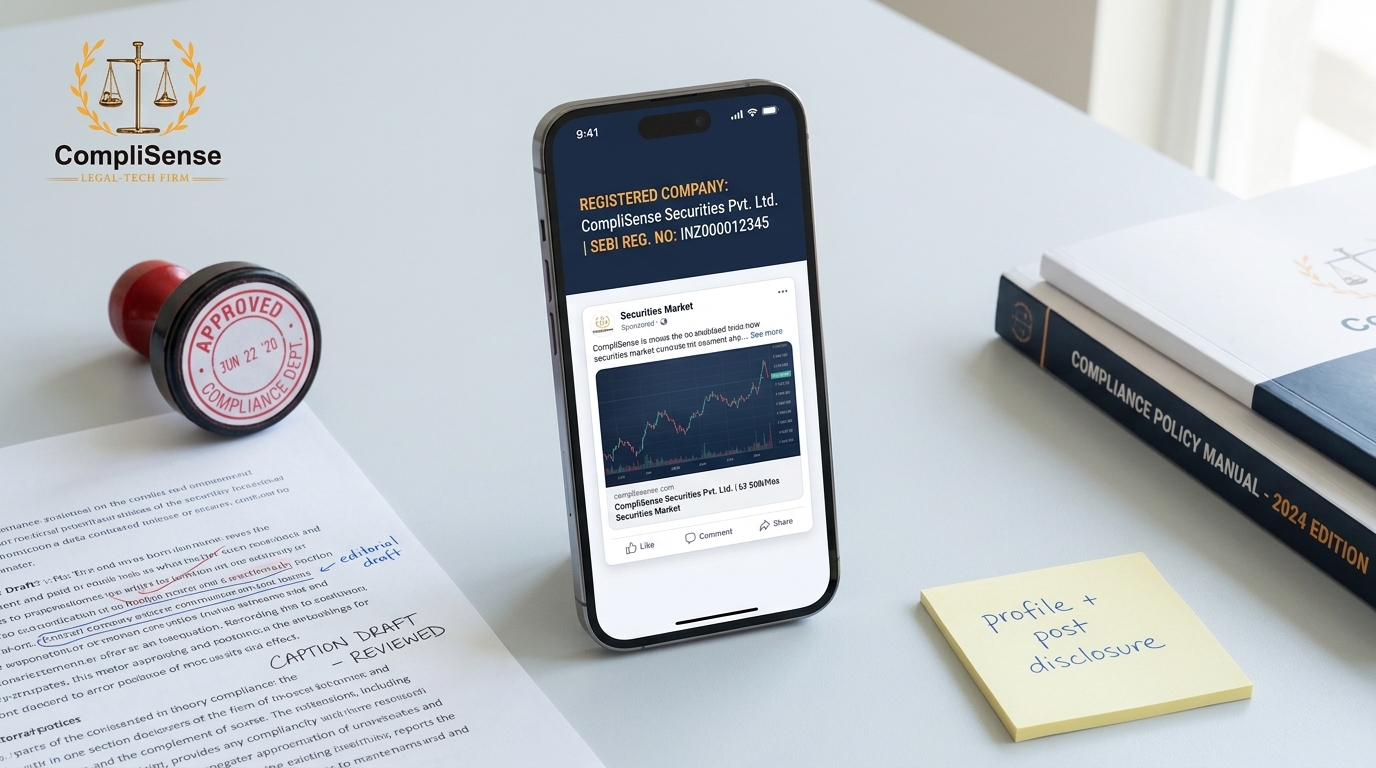
Social media has become a serious compliance surface for SEBI-regulated entities.
A few years ago, a broker’s Instagram reel, a distributor’s WhatsApp broadcast, or a research-related LinkedIn post may have been viewed mainly as marketing or client communication. That line is now becoming much thinner. When securities-market content is published on social media, investors often cannot easily distinguish between a SEBI-registered entity, an agent of such an entity, and an unregistered person giving market-facing views.
That is the regulatory gap SEBI addressed through its November 2025 consultation paper on disclosure of registered name and registration number by SEBI-regulated entities and their agents on Social Media Platforms. The proposal later moved into a February 2026 circular, making the direction of travel clear: identity, registration status, and capacity should not remain hidden behind a handle name, brand account, channel name, or informal creator-style page.
For compliance teams, the important point is not only the final rule. The important point is what the consultation itself showed. SEBI is treating social media content as part of the regulated communication ecosystem.
The proposal was simple in concept but operationally significant. Where a regulated entity or its agent posts content relating to the securities market, the investor should be able to see who is speaking, under what registered name, and in what regulatory capacity. This matters because many financial decisions are influenced by short videos, posts, reels, closed groups, message channels, webinars, and bite-sized market commentary.
For entities with a single SEBI registration, the preparation is relatively straightforward. The registered name and registration number need to be kept ready for display on the social media profile and at the beginning of relevant securities-market content. But even here, the practical challenge is not small. Compliance teams need to identify all official handles, business-line pages, regional pages, campaign accounts, employee-led official pages, and any handles operated by agencies or outsourced marketing teams.
The bigger challenge is for entities with multiple registrations. A financial group may operate as a stock broker, investment adviser, research analyst, PMS provider, AIF manager, mutual fund distributor, or in other capacities. A single brand handle may carry content across multiple business lines. In such cases, the compliance issue is not merely “add a registration number”. It is to decide which registration is relevant to which content.
That means every post should be reviewed not only for content risk, but also for capacity risk. Is the post being made as a broker? As an adviser? As a distributor? As a research-related communication? As generic investor education? The disclosure should match the capacity in which the content is being published.
Agents and distributors also need special attention. SEBI’s proposal recognised that agents of regulated entities can influence investor behaviour. If an agent posts securities-market-related content, the investor should not be left guessing the connection between the agent and the principal regulated entity. This creates a new operational need for principal-agent mapping, approval controls, and clear disclosure wording.
The practical preparation should begin with a social media inventory. Many regulated entities know their main LinkedIn, X, Instagram, YouTube, Facebook, and website channels. Fewer have a clean register of every business-linked handle, campaign page, Telegram channel, WhatsApp community, employee-operated official communication group, or outsourced marketing account. Without that inventory, implementation becomes reactive and inconsistent.
The second step is to prepare a registration disclosure register. This should contain the exact SEBI-registered name, registration number, category of registration, business unit, approved short disclosure text, and the situations in which each disclosure must be used. For entities with multiple registrations, this register should be mapped to content categories so that marketing, business, compliance, and legal teams are not deciding from scratch every time a post is created.
The third step is to update the content approval workflow. Social media posts should not be checked only for design, grammar, disclaimers, and brand tone. The reviewer should also verify whether the post relates to the securities market, whether the correct registered entity is identified, whether an agent or distributor relationship is involved, and whether the disclosure appears at the right place in the content. Video content requires particular care. If the disclosure is required at the beginning of the content, it should not be buried in a caption, a later frame, a description box, or a comment. Teams should create approved templates for reels, shorts, webinars, explainer videos, and market education clips so that disclosure placement becomes automatic.
The fourth step is to revisit agency and influencer arrangements. Where external agencies, affiliates, distributors, authorised persons, or content partners create securities-market-related content, contracts and SOPs should clearly state the disclosure requirement, approval requirement, recordkeeping expectation, and consequences of non-compliance. The regulated entity should not discover a non-compliant post only after it is live.
The fifth step is recordkeeping. Social media compliance is difficult to prove retrospectively unless screenshots, post URLs, approval logs, version history, and takedown records are preserved. Compliance teams should maintain evidence of what was posted, when it was approved, who approved it, which disclosure was used, and whether any correction was made later.
This change also has a cultural angle. Marketing teams often work at platform speed. Compliance teams work at evidence speed. SEBI’s move effectively requires both teams to meet in the middle. The solution is not to slow down every post. The solution is to standardise templates, pre-approved disclosure language, capacity mapping, and escalation rules.
For SEBI-regulated entities, the message is clear. Social media is no longer just a visibility channel. It is a regulated communication channel where identity and accountability matter. The entities that prepare early will not treat this as a last-minute profile-editing exercise. They will treat it as a content governance change.
Related compliance hubs
Continue from this explainer into topic hubs that connect analysis with regulator updates and workflow context.
Related regulator archives
Continue into source-linked archives for regulators connected to this topic area.
Related articles
Continue with related analysis selected by the editorial team or sharing the same topics.
Related legal updates
Source-linked updates that place this article in the current regulatory workflow.
Content accountability
Prepared by CompliSense Editorial Desk (Regulatory Content Team) and reviewed by CompliSense Regulatory Review Desk (Compliance Review Team).
This attribution reflects the preparation and review roles used for CompliSense regulatory publishing.