Verified Labels for Broker Apps, RA/IA Audit Clarifications, and Mutual-Fund Borrowing: Why March 2026 Matters
Three March 2026 SEBI developments point in the same direction: stronger digital trust, broader compliance-assurance capacity and tighter governance around operational liquidity.
- sebi
- stock brokers
- trading apps
- verified app label
- research analysts
- investment advisers
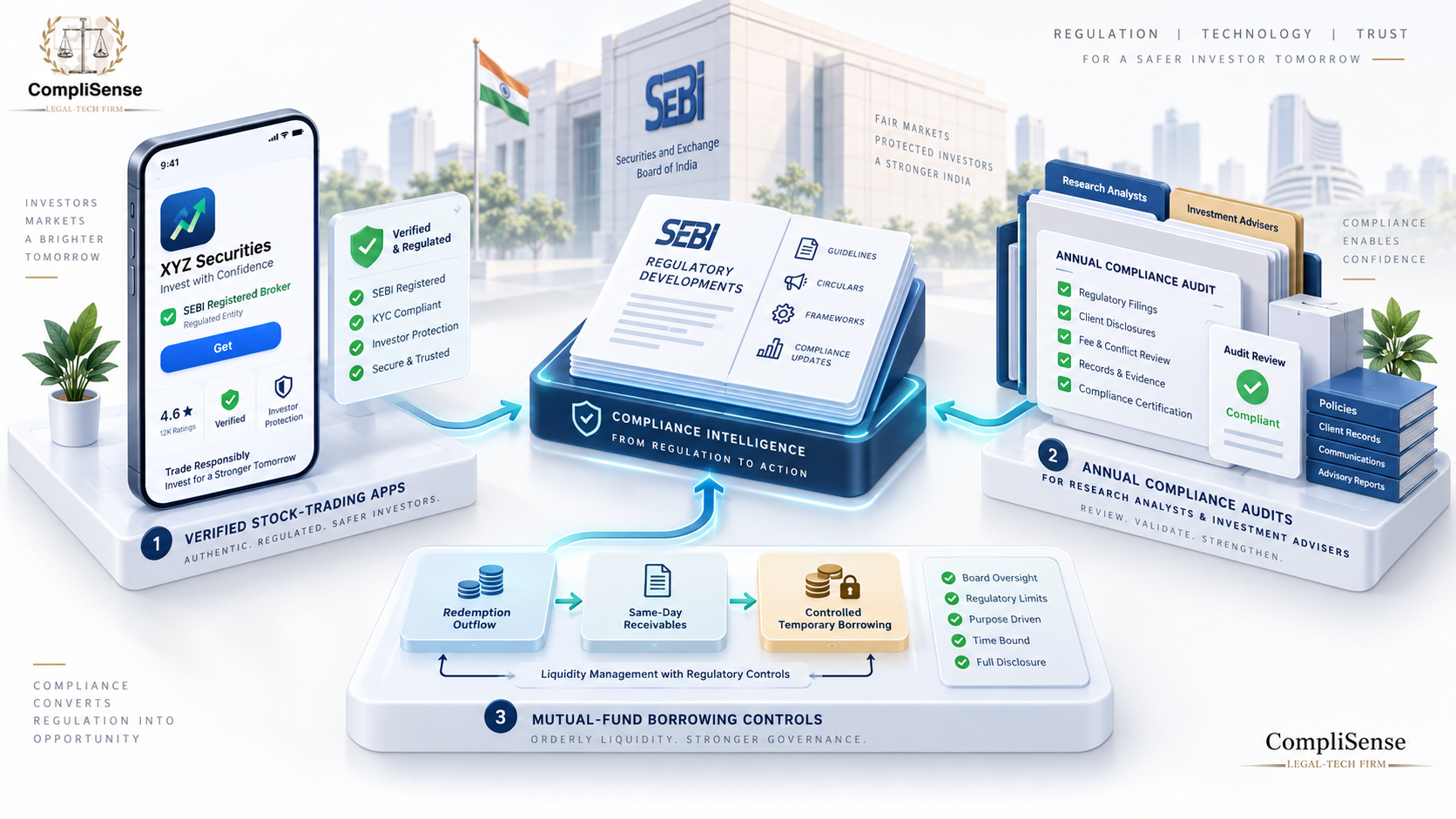
Three March 2026 SEBI developments point in the same direction: stronger digital trust, broader compliance-assurance capacity and tighter governance around operational liquidity.
1. Three Very Different Changes, One Operational Message
March 2026 produced three SEBI developments that appear unrelated at first. A verified label was introduced for genuine stock-broker trading apps on Google Play; SEBI clarified who may conduct the annual compliance audits of Research Analysts and Investment Advisers; and a new borrowing framework was prescribed for mutual funds, including intraday liquidity arrangements.
The subject matter is different, but the regulatory direction is remarkably consistent. SEBI is increasingly trying to solve compliance problems inside the operating environment where the risk actually occurs. App impersonation is being addressed at the distribution platform. Compliance assurance is being strengthened through the audit framework. Temporary liquidity mismatches in mutual funds are being recognised, but brought within defined governance and borrowing controls. For Compliance teams, the lesson is that these are not simply circulars to archive—they alter how trust, assurance and operational exceptions should be managed.
2. Verified Broker Apps: Trust Is Moving Into the Distribution Layer
On 25 March 2026, SEBI launched the Verified App Label initiative in collaboration with Google. Stock-trading applications associated with SEBI-registered brokers can now display a “Verified” label on Google Play, helping investors distinguish genuine trading applications from fraudulent or impersonating apps. SEBI stated that the label had already been deployed for more than 600 apps, with plans to extend the initiative to apps of other regulated intermediaries in due course.
This is important because fake trading apps create a problem that conventional disclosures cannot solve effectively. A fraudulent application can copy branding, logos and even interface elements from a genuine broker. By the time an investor is reading a disclaimer inside the application, the more fundamental question—whether the app itself is genuine—may already have been answered incorrectly.
For brokers, the initiative should therefore be viewed as part of their broader digital identity control environment. Firms should maintain a clear inventory of authorised apps, ensure links from official websites and communications point to genuine app-store listings, and have escalation mechanisms for impersonating applications. A verified label is a useful investor-protection layer, but it does not eliminate risks from fake websites, misleading advertisements or applications installed outside official stores. SEBI itself highlighted side-loading as a continuing concern.
The broader compliance principle is simple: protecting a regulated brand increasingly means controlling not only what the firm says, but also where investors encounter and authenticate that firm digitally.
3. RA and IA Audit Clarifications: Broader Auditor Choice, Not a Lighter Audit
Also on 25 March 2026, SEBI issued separate circulars for Research Analysts and Investment Advisers clarifying that members of the Institute of Cost Accountants of India are eligible to conduct their annual compliance audits. This places Cost Accountants alongside members of the Institute of Chartered Accountants of India and Institute of Company Secretaries of India for this purpose.
The clarification matters operationally because it expands the pool of professionals available to conduct these audits. It does not, however, dilute the underlying annual-audit requirement. RAs and IAs remain responsible for ensuring that the audit covers compliance with the applicable regulations and SEBI circulars, and the existing timelines continue to matter. For RAs, for example, the audit is to be completed within six months from the end of the financial year, with the compliance audit report submitted within one month of the audit report and adverse findings and action taken subject to the prescribed reporting timeline.
That distinction is worth emphasising because an “ease of doing business” clarification can easily be misread as a reduction in compliance intensity. Here, SEBI has widened who can provide assurance, not reduced what needs to be assured.
For RAs and IAs preparing for the FY 2025–26 audit cycle, the better response is to focus early on evidence readiness. Client agreements, risk profiling, segregation controls, disclosures, fee records, communications and other regulated processes should not first be assembled when the auditor requests them. Annual audit works best when the entity can continuously demonstrate compliance rather than reconstruct it retrospectively.
4. Mutual-Fund Borrowing: Recognising a Real Liquidity Problem, but Putting Governance Around It
SEBI’s 13 March 2026 circular on borrowing by mutual funds addresses a very different operational problem. Liquid and overnight schemes may have to make redemption payments in the morning of T+1 while receiving maturity proceeds from instruments such as TREPS or reverse repo only later that day. Intraday borrowing is therefore sometimes used to bridge a timing mismatch rather than a genuine deficiency in scheme assets.
Under the SEBI (Mutual Funds) Regulations, 2026, regular scheme borrowing is permitted for specified purposes subject generally to a ceiling of 20% of the scheme’s net assets and a maximum duration of six months. The March circular separately prescribed conditions for intraday borrowing, including an AMC and trustee-approved policy and limits linked to specified same-day receivables. Importantly, costs or losses arising from certain failures or delays in those identified receivables are to be borne by the AMC rather than passed to the scheme.
The implementation story then became even more interesting. On 25 March, SEBI issued an addendum postponing the applicability of the intraday-borrowing guidelines to 15 July 2026, specifically citing operational challenges raised by AMCs.
That postponement should be treated as implementation time, not as a reason to postpone implementation thinking. AMCs and trustees need policies, eligible-receivable logic, borrowing limits, bank arrangements, accounting treatment, monitoring and escalation controls to work together before the framework becomes operational.
5. What Compliance Teams Should Take From These Changes
Taken together, these developments illustrate three different kinds of control that Compliance increasingly needs to understand.
- Identity controls: can investors distinguish the regulated digital channel from an impersonator?
- Assurance controls: can the entity demonstrate compliance through a credible independent audit?
- Operational controls: can a legitimate business exception—such as an intraday liquidity mismatch—be accommodated without weakening investor safeguards?
The practical response is not to create three disconnected regulatory tasks. Each change should be mapped to its real owner. The broker-app initiative involves Compliance, Cybersecurity, Product and Digital teams. RA/IA audit readiness involves management, Compliance and the relevant business function. Mutual-fund borrowing requires coordination among Fund Management, Operations, Treasury, Risk, Compliance and trustees.
That cross-functional ownership is increasingly where regulatory implementation succeeds or fails.
6. Key Takeaway
March 2026 shows an important evolution in SEBI’s regulatory approach. Investor protection is increasingly being designed into platform identity, compliance assurance and operating processes, rather than being addressed only through additional disclosure or reporting.
For brokers, being regulated must become easier for an investor to verify. For RAs and IAs, compliance must remain capable of independent examination even as the eligible auditor pool expands. For mutual funds, genuine liquidity-management needs are recognised, but only within a defined governance framework.
The common compliance question is therefore:
Can the organisation demonstrate that the regulatory safeguard works in the actual process—not merely that the relevant circular has been read?
That is the March theme worth paying attention to.
Related compliance hubs
Continue from this explainer into topic hubs that connect analysis with regulator updates and workflow context.
Related regulator archives
Continue into source-linked archives for regulators connected to this topic area.
Related articles
Continue with related analysis selected by the editorial team or sharing the same topics.
Related legal updates
Source-linked updates that place this article in the current regulatory workflow.
Content accountability
Prepared by CompliSense Editorial Desk (Regulatory Content Team) and reviewed by CompliSense Regulatory Review Desk (Compliance Review Team).
This attribution reflects the preparation and review roles used for CompliSense regulatory publishing.