March 2026 SEBI Board and Circular Themes: What Compliance Teams Should Actually Pay Attention To
March 2026 brought a wide spread of SEBI changes. The real theme was not deregulation, but smarter controls: less duplicate reporting, stronger investor safeguards and greater accountability for how firms implement regulatory change.
- sebi
- sebi board meeting
- stock brokers
- aif
- mutual funds
- fpi
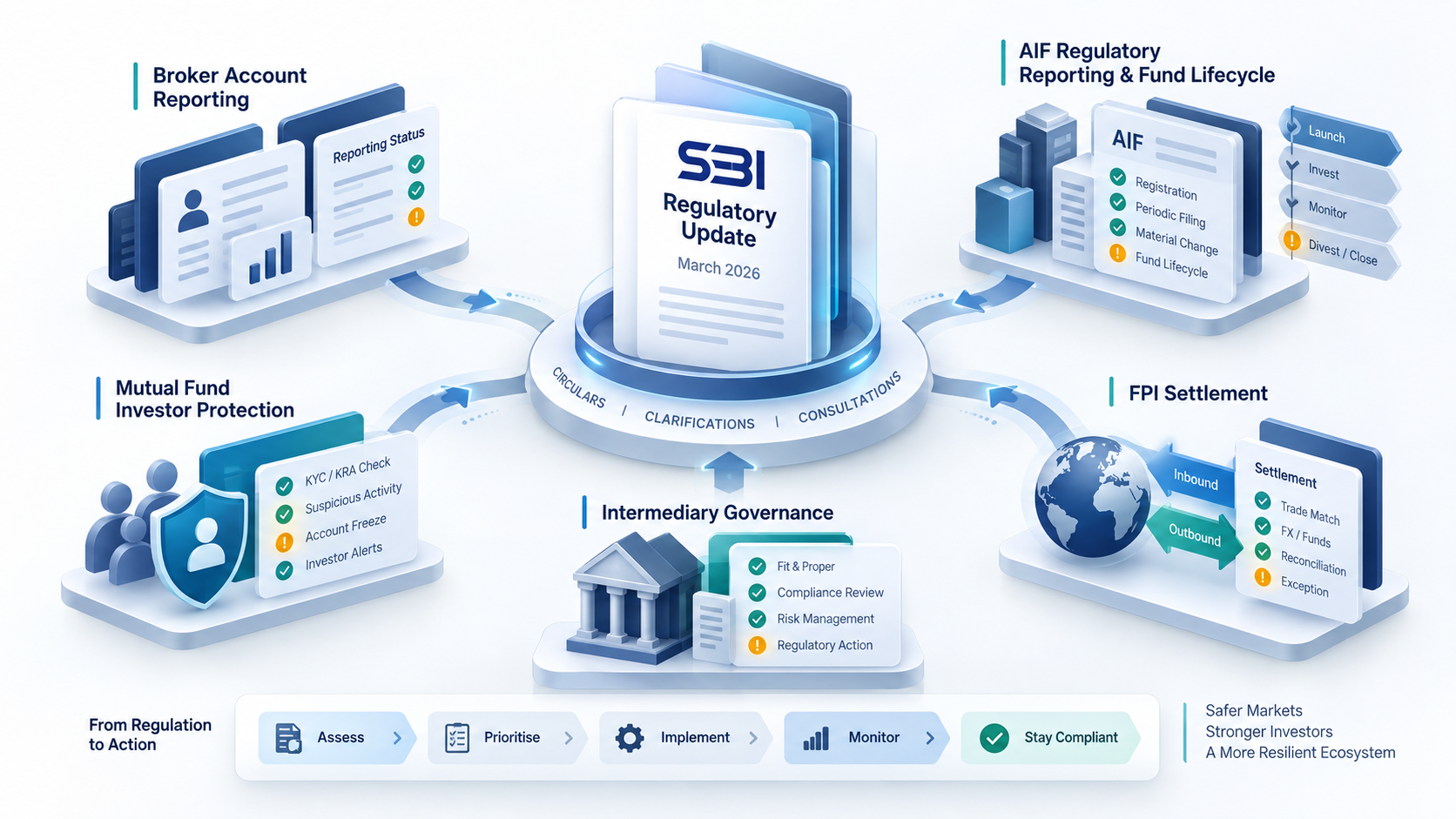
March 2026 brought a wide spread of SEBI changes. The real theme was not deregulation, but smarter controls: less duplicate reporting, stronger investor safeguards and greater accountability for how firms implement regulatory change.
1. March Was Not About One Big Rule
March 2026 produced the kind of regulatory month that can overwhelm a Compliance team precisely because there was no single headline change. SEBI issued measures affecting AIF reporting, mutual-fund investor controls, research-services certification, borrowing and broker reporting, while the 23 March Board meeting approved changes touching AIF wind-downs, FPI settlement, InvITs and REITs, the “fit and proper” framework and SEBI’s own conflict-of-interest regime.
Trying to summarise every item equally would miss the useful point. For Compliance teams, March is better read as a collection of operational themes: regulators removing duplicative obligations where data can already be obtained elsewhere, giving institutions more flexibility where old rules created friction, but at the same time expecting better data, clearer ownership and stronger controls around the obligations that remain.
2. Ease of Doing Business Does Not Mean “Do Less Compliance”
The clearest example came from SEBI’s 23 March circular on stock-broker reporting. The requirement for brokers to separately report their demat accounts to stock exchanges was removed, with depositories providing this information directly. Brokers that are also banks or primary dealers also received targeted relief for accounts used outside stock-broking activities. The changes take effect from 17 April 2026.
The operational lesson is important. When SEBI removes a filing, Compliance should not simply delete a calendar entry and move on. Firms need to identify exactly which obligation has disappeared, which underlying account-tagging or nomenclature controls remain, and whether downstream SOPs, compliance masters and internal reports still contain the old requirement.
Ease-of-doing-business measures create their own implementation work. Bad regulatory change management can leave teams continuing obsolete filings for months—or, worse, removing controls that SEBI never actually relaxed.
3. Investor-Control Features Are Becoming Operational Requirements
The 6 March voluntary lock-in/debit-freeze framework for mutual-fund folios is another useful signal. SEBI introduced a facility enabling investors to prevent debits from their mutual-fund holdings until the folio is unlocked, with the framework applying across demat and non-demat holdings and coming into effect from 30 April 2026.
This may appear to be an investor-service feature rather than a Compliance issue. In reality, controls of this kind affect transaction processing, authentication, investor communication, exception handling and auditability. An AMC or RTA has to know whether a folio is frozen before processing an otherwise valid transaction and must be able to demonstrate how the freeze or unfreeze instruction was authenticated.
The broader direction is worth watching: investor protection is increasingly being embedded directly into system behaviour, not merely into disclosures and grievance procedures.
4. AIF Compliance Is Moving Toward More Proportionate Reporting
SEBI’s 4 March circular on AIF regulatory reporting changed the reporting architecture from a uniform quarterly exercise toward a combination of a comprehensive Annual Activity Report and a more limited Quarterly Activity Report, with online reporting through SEBI’s intermediary infrastructure.
The Board then addressed a different but related AIF problem on 23 March: funds that have effectively stopped active fund management but cannot surrender registration because money must still be retained for litigation, tax demands or residual expenses. SEBI approved an “inoperative fund” framework with lighter compliance requirements, subject to conditions, including situations involving documented liabilities and investor consent.
Taken together, the message is not simply “less reporting for AIFs.” It is more proportionate reporting based on what the fund is actually doing. AIF managers should therefore pay close attention to fund status, reporting classification, supporting records and transition controls rather than treating every regulatory change as an isolated filing amendment.
5. “Fit and Proper” Is Becoming More Nuanced—but More Event-Driven
One of the most important Board decisions for intermediaries was the overhaul of the fit and proper person criteria. Among other changes, the mere pendency of certain complaints or proceedings will no longer automatically produce the same disqualification outcome, while SEBI retains principle-based assessment. At the same time, intermediaries will be required to report specified events involving themselves, KMPs or persons in control within 15 working days.
This is a good example of regulatory simplification creating a different kind of compliance responsibility. Firms may receive more nuanced treatment, but they need stronger mechanisms to identify relevant developments involving key persons and escalate them promptly. That requires coordination between Compliance, Legal, HR, Company Secretarial teams and senior management.
A fit-and-proper declaration reviewed once a year is increasingly insufficient if the regulatory framework expects event-based visibility.
6. Market Infrastructure Changes Need Long Implementation Runways
The Board also approved net settlement of funds for eligible FPI cash-market transactions, while securities settlement will continue on a gross basis. SEBI expressly recognised the funding and foreign-exchange costs created by the existing gross-funds process and provided an implementation runway until 31 December 2026 because system and process changes will be required.
This is the kind of Board decision Compliance teams should track even when no immediate filing becomes due tomorrow. Custodians, brokers, banks and technology teams need time to understand the eventual operating model, revise reconciliation logic, test settlement flows and update controls.
A strong regulatory-change process therefore separates developments into at least two buckets: action required now and implementation watchlist. Board decisions often belong in the second bucket until detailed regulations or circulars operationalise them.
7. The Common Thread: Regulation Is Moving Closer to Operations
Across these changes, SEBI appears to be removing some compliance friction while asking firms to build more reliable operational controls. Duplicate reporting can be removed where market infrastructure already holds the data. Investor-protection mechanisms can be embedded directly into transaction systems. Reporting can be calibrated to the actual status of a fund. Eligibility assessments can become more principle-based while requiring faster event reporting.
For Compliance teams, that changes the job. The question is increasingly not simply “What circular was issued?” but “Which process, system, owner, data field or control changes because of it?”
A practical March review should therefore result in concrete changes to compliance masters, SOPs, system requirements, reporting calendars and management watchlists—not another folder containing March circular PDFs.
8. Key Takeaway
The most important March 2026 SEBI theme is neither tightening nor relaxation. It is operationalisation.
Some requirements are becoming easier. Others are becoming more sophisticated. But across both, SEBI increasingly expects regulatory requirements to be reflected accurately in the systems and processes through which securities-market activity actually occurs.
For Compliance teams, the real skill is therefore not tracking more circulars. It is distinguishing between what requires an immediate task, what requires a process redesign and what needs to remain on an implementation watchlist until the next regulatory step arrives.Stock Brokers, Depository Participants, Alternative Investment Funds, AIF Managers, Mutual Funds, Asset Management Companies, RTAs, Research Analysts, Foreign Portfolio Investors, Custodians, InvITs, REITs, SEBI Registered Intermediaries
Related compliance hubs
Continue from this explainer into topic hubs that connect analysis with regulator updates and workflow context.
Related regulator archives
Continue into source-linked archives for regulators connected to this topic area.
Related articles
Continue with related analysis selected by the editorial team or sharing the same topics.
Related legal updates
Source-linked updates that place this article in the current regulatory workflow.
Content accountability
Prepared by CompliSense Editorial Desk (Regulatory Content Team) and reviewed by CompliSense Regulatory Review Desk (Compliance Review Team).
This attribution reflects the preparation and review roles used for CompliSense regulatory publishing.