Pledge Creation and Invocation Through Depositories: What the February 2026 SEBI Circular Means in Practice
SEBI’s February 2026 circular tightens the pledge framework through standardised forms, statutory undertakings and invocation notifications. For depository operations teams, the change is as much about process evidence as documentation.
- sebi
- depositories
- depository participants
- nsdl
- cdsl
- pledge of securities
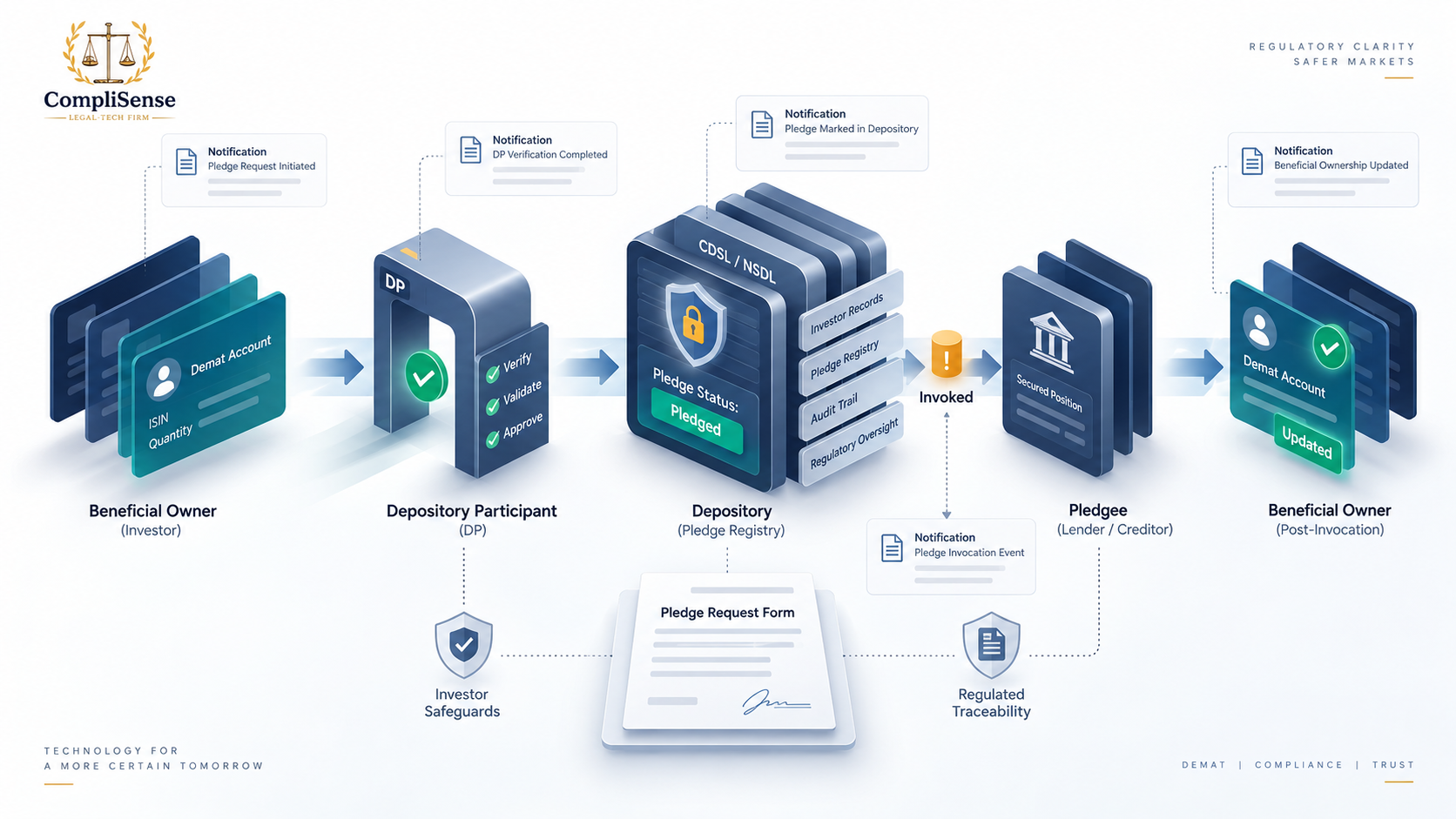
SEBI’s circular dated 5 February 2026 does not redesign the basic mechanism for pledging securities through the depository system. What it does is make some of the legal safeguards around that mechanism much harder to treat as being outside the operational process.
The circular inserts additional requirements into paragraph 4.13 of SEBI’s Master Circular for Depositories. Depositories must standardise the Pledge Request Form, capture specific undertakings from the pledger and pledgee, and notify both parties when a pledge is invoked and the pledgee is recorded as the beneficial owner. The framework must be implemented on or before 6 April 2026.
For depositories and their participants, this is therefore not simply a form change. It affects documentation, system design, notifications and the audit trail around a transaction that can ultimately result in pledged securities being sold.
1. What SEBI Has Changed
SEBI’s circular dated 5 February 2026 tightens the framework governing creation and invocation of pledges through the depository system. The existing mechanism under Regulation 79 of the SEBI (Depositories and Participants) Regulations, 2018 already prescribed how a beneficial owner creates a pledge through its Depository Participant, how the pledgee provides concurrence and how the depository records the pledge. The February circular does not replace that mechanism. Instead, it introduces additional safeguards around the documentation and invocation stages so that the electronic depository process better reflects the legal rights of the parties under the Indian Contract Act, 1872. Depositories are required to implement the changes on or before 6 April 2026, including necessary amendments to their bye-laws and rules and any required system changes. (Securities and Exchange Board of India)
The practical changes are concentrated in three areas: the Pledge Request Form must contain prescribed undertakings from the pledger and pledgee; depositories must maintain a standardised format for that form; and, when a pledge is invoked, both parties must be notified that invocation has occurred and that the pledgee has been recorded as the beneficial owner. What appears to be a relatively narrow procedural circular therefore affects documentation, system configuration, communications and the audit trail surrounding pledge transactions. (Securities and Exchange Board of India)
2. The Pledge Request Form Now Carries Greater Legal Weight
The most important change is the incorporation of specific undertakings into the Pledge Request Form. The pledgee must undertake to provide reasonable notice to the pledger and comply with Sections 176 and 177 of the Indian Contract Act, 1872. Both the pledger and pledgee must also undertake to comply with the Indian Contract Act, the Depositories Act, SEBI regulations, applicable circulars and relevant bye-laws. SEBI has therefore brought obligations that might previously have sat primarily within loan documents or contractual arrangements directly into the depository pledge documentation. (Securities and Exchange Board of India)
This matters because the depository entry is not merely an administrative record. Invocation can ultimately result in the pledgee becoming the recorded beneficial owner of the securities, and the pledged assets may subsequently be sold. The revised form creates a clearer evidentiary link between the electronic transaction and the legal obligations accepted by the parties. For operations teams, implementing the circular should therefore involve more than replacing an old PDF with a new one. Physical forms, digital journeys, APIs, back-office screens and other permitted initiation channels should all be checked to ensure that the prescribed undertakings are captured consistently and can be retrieved later if the transaction is questioned.
3. Invocation and Sale Should Not Be Treated as the Same Event
A particularly important operational distinction is the difference between invocation of the pledge and the subsequent sale of pledged securities. Under Regulation 79, invocation allows the depository to record the pledgee as the beneficial owner in accordance with the applicable pledge arrangement. The February circular then expressly brings Sections 176 and 177 of the Indian Contract Act into the Pledge Request Form, including the pledgee’s undertaking regarding reasonable notice before sale. (Securities and Exchange Board of India)
This distinction is easy to lose in an automated workflow. A system may successfully process an invocation instruction, change the beneficial-owner record and mark the transaction complete from a depository-processing perspective. That does not by itself answer whether all conditions relevant to a subsequent sale have been satisfied. Operations, Legal and Compliance teams therefore need clearly defined hand-offs between invocation and enforcement. Where securities may be sold following default, the organisation should be capable of establishing whether the required notice was issued, when it was issued, how it was communicated and whether any redemption or dispute arose before the sale. The circular does not prescribe a universal number of days constituting “reasonable notice”; the control framework must therefore work with the applicable legal and contractual requirements rather than reducing the concept to a generic system timer. (Securities and Exchange Board of India)
4. Invocation Now Needs a Stronger Audit Trail
SEBI now requires the depository, at the time of invocation, to send an intimation or notification to both the pledger and pledgee confirming that the pledge has been invoked and that the pledgee has been recorded as the beneficial owner under Regulation 79(8). This turns notification into a formal component of the transaction trail rather than an incidental system communication. (Securities and Exchange Board of India)
A well-controlled process should therefore allow the transaction to be reconstructed from beginning to end. The institution should be able to determine when the pledge request was received, whether the securities were available for pledge, when pledgee concurrence was obtained, when the pledge was created, whether the relevant parties were informed, when invocation subsequently occurred and when the invocation notification was generated. Under the underlying Regulation 79 framework, the depository is ordinarily required to create and record the pledge within 15 days of receiving the application, after concurrence from the pledgee through its participant. The February changes add further evidence around what happens when that pledge is eventually invoked. (Securities and Exchange Board of India)
That evidence becomes especially important when a dispute emerges months later. A technically successful transaction is useful; a transaction whose chronology, approvals, notifications and supporting records can be demonstrated is considerably stronger.
5. Why Standardisation Matters
SEBI has also required depositories to maintain a standardised Pledge Request Form. This may sound administrative, but standardisation is important in a process carrying significant legal consequences. If declarations or undertakings differ depending on whether a pledge originates through a physical form, digital channel or another operating route, two economically identical transactions may produce different compliance records. The circular is effectively reducing that variability by ensuring that certain minimum legal acknowledgements are built into the process itself. (Securities and Exchange Board of India)
For Depository Participants, the implementation question should therefore not be limited to whether the latest form has been circulated to branches. Teams should examine the complete operating environment and ask whether every permitted route into the pledge process captures the same mandatory information and produces equivalent evidence. Legacy forms, cached templates, branch-level documentation and digital interfaces are obvious places where an old process can survive even after a policy team considers implementation complete.
6. What Depository Operations Teams Should Review
The circular is directly addressed to depositories, which must amend their relevant rules and bye-laws, make system changes where required and communicate the new requirements to participants. For DPs, however, those changes flow directly into day-to-day pledge processing. Waiting until the implementation date to discover how revised forms or system validations affect operations creates unnecessary risk. (Securities and Exchange Board of India)
Before the revised framework becomes operational, teams should review a focused set of areas:
pledge creation and invocation SOPs;
physical and electronic Pledge Request Forms;
maker-checker and authorisation controls;
pledgee concurrence records;
invocation notifications and delivery evidence;
interfaces between Operations, Legal and Compliance; and
retention and retrieval of the complete transaction history.
The objective is not to create a new approval layer wherever one does not exist today. It is to make sure that the revised legal safeguards are actually reflected in the channels through which pledge transactions are processed.
7. The Bigger Message Is Procedural Discipline
The significance of the February 2026 circular lies less in introducing a new concept of pledge and more in strengthening the evidence around an existing one. The creation of the pledge, the undertakings of the parties, invocation, change in beneficial ownership, notification and any subsequent enforcement need to fit together as one traceable process rather than exist as disconnected legal and operational events.
For depository operations teams, the stronger control model is therefore:
Request → Undertakings → Verification → Concurrence → Pledge Creation → Invocation → Notification → Applicable Notice Before Sale → Evidence
The key compliance question after 6 April should not merely be whether the system successfully allows a pledge to be created and invoked. It should be whether the institution can later demonstrate how the pledge was created, what the parties undertook, when it was invoked, who was informed and whether the safeguards relevant to any subsequent sale were observed.
That is where the February circular has its real operational effect.
Related compliance hubs
Continue from this explainer into topic hubs that connect analysis with regulator updates and workflow context.
Related regulator archives
Continue into source-linked archives for regulators connected to this topic area.
Related articles
Continue with related analysis selected by the editorial team or sharing the same topics.
Related legal updates
Source-linked updates that place this article in the current regulatory workflow.
Content accountability
Prepared by CompliSense Editorial Desk (Regulatory Content Team) and reviewed by CompliSense Regulatory Review Desk (Compliance Review Team).
This attribution reflects the preparation and review roles used for CompliSense regulatory publishing.