The Income-tax Act, 2025 Is Now Live: What the Transition Means for Businesses and Compliance Teams
India’s new Income-tax Act is now in force, but the 1961 Act has not disappeared from day-to-day compliance. FY 2026–27 is a transition year requiring businesses to manage old and new tax frameworks in parallel.
- income-tax act 2025
- income-tax rules 2026
- cbdt
- tax year
- income tax compliance
- corporate tax
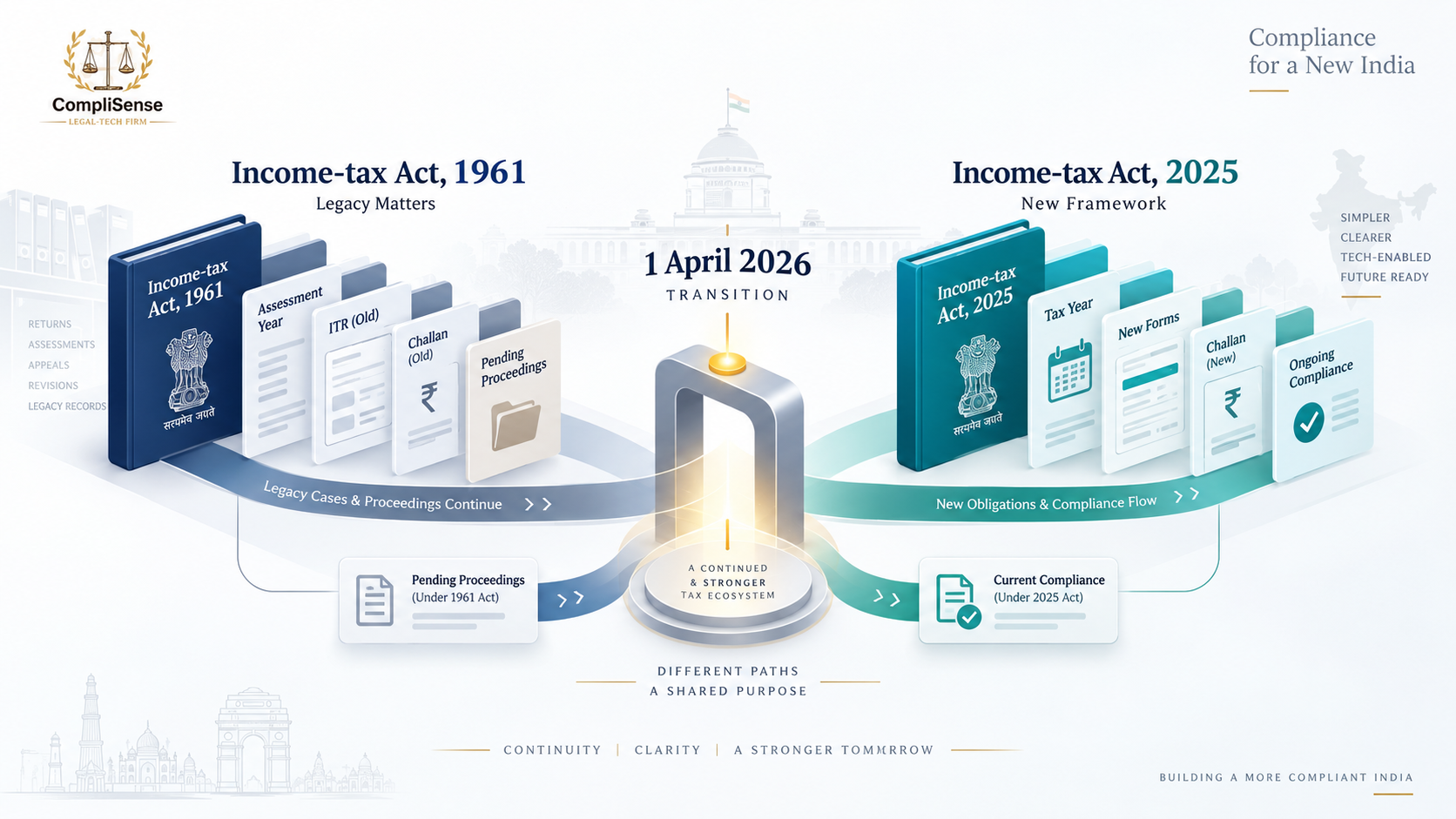
From 1 April 2026, the Income-tax Act, 2025 formally replaced the Income-tax Act, 1961 as India’s principal direct-tax legislation. The Income-tax Rules, 2026 also came into force on the same date, accompanied by redesigned forms and a new statutory architecture intended to make the law simpler and easier to navigate. CBDT has been clear that the reform is principally one of simplification and restructuring rather than the introduction of an entirely new tax policy.
For businesses, however, 1 April was not a clean switch from one law to another. FY 2026–27 begins with two tax frameworks operating side by side for different periods and proceedings. Income arising before 1 April continues to carry the legal consequences of the 1961 Act, while income and obligations arising from 1 April onwards move into the 2025 Act. That makes this less a tax-rate story and more a regulatory-change-management exercise.
1. The First Thing to Understand: The Old Act Is Repealed, Not Erased
Section 536 repeals the Income-tax Act, 1961 from 1 April 2026, but its savings provisions preserve earlier rights, liabilities and proceedings. An assessment, appeal, reassessment, rectification, refund claim or other proceeding relating to a period governed by the old law does not suddenly migrate into the new Act merely because activity on the case happens after 1 April. CBDT’s transition guidance expressly confirms that proceedings relating to tax years beginning before 1 April 2026 continue under the 1961 Act.
This distinction is critical for Compliance, Finance and Tax teams. During FY 2026–27, an organisation may be responding to an old assessment notice under the 1961 Act, paying advance tax under the 2025 Act, filing an AY 2026–27 return under the old Act and simultaneously carrying out current-year TDS obligations under the new framework.
In other words, the transition does not produce one new compliance universe. For a period, it produces two.
2. “Tax Year” Changes the Vocabulary—Not the Financial Year
One of the most visible changes is the introduction of the term “Tax Year”, replacing the old distinction between “Previous Year” and “Assessment Year” for periods governed by the 2025 Act. Income earned between 1 April 2026 and 31 March 2027 belongs to Tax Year 2026–27. Businesses do not need to alter their accounting year or financial-statement cycle because the Tax Year remains aligned with the financial year.
The transition year nevertheless creates an easy source of confusion:
- Income for FY 2025–26 remains governed by the 1961 Act and is reported as AY 2026–27.
- Income from 1 April 2026 to 31 March 2027 is governed by the 2025 Act and belongs to Tax Year 2026–27.
The similar-looking references are precisely why internal templates, payment instructions, tax trackers and review checklists need attention. A user selecting “2026–27” without knowing whether the system expects an Assessment Year or Tax Year can allocate a transaction to the wrong statutory period.
3. Forms and Challans Now Need a Two-Track Control
The e-Filing environment illustrates the transition particularly well. CBDT has enabled forms under the Income-tax Act, 2025 from 1 April and new challans for payments relating to Tax Year 2026–27. At the same time, returns relating to income earned during FY 2025–26 continue to be filed for AY 2026–27 under the Income-tax Act, 1961, even though those returns are being filed after the new Act has taken effect.
Businesses therefore need more than an updated tax calendar. Payment and filing workflows should explicitly identify which Act and period the transaction belongs to before the form or challan is selected.
For example, self-assessment tax relating to FY 2025–26 paid in June 2026 remains linked to AY 2026–27 under the old Act. Advance tax on income earned during FY 2026–27 belongs to Tax Year 2026–27 under the new Act. CBDT has specifically cautioned taxpayers to make the correct distinction so that tax credits are mapped properly.
4. Internal References Need a Controlled Migration
The new Act is substantially reorganised. CBDT describes a reduction from 819 sections under the earlier framework to 536 sections, with provisions reorganised and many explanations and provisos integrated into the statutory text. The new Rules similarly restructure the compliance framework and forms.
That means businesses should not limit implementation to the tax department. References to the 1961 Act may sit across internal tax manuals, accounting SOPs, board papers, vendor documentation, payroll procedures, TDS checklists, ERP configurations, internal controls and standard legal templates.
The correct response is not a global find-and-replace exercise. An old section reference may remain completely correct where the document relates to FY 2025–26 or an earlier assessment year. Instead, organisations need a controlled mapping between old and new provisions, with documentation distinguishing legacy matters from current-year requirements. CBDT itself provides comparison utilities for the two Acts, Rules and forms to support this transition.
5. Legacy Proceedings Need Their Own Compliance Lane
One of the biggest practical mistakes would be to archive the 1961 Act simply because it has been repealed.
Appeals relating to AY 2026–27 or earlier continue under the old Act even when filed after 1 April 2026. Earlier tax demands remain payable, existing recovery actions continue to have effect, and rights such as qualifying refund claims survive the repeal. Similarly, losses and eligible MAT/AMT credits originating under the earlier framework may continue into the new regime subject to the transition provisions.
Businesses should therefore maintain a separate legacy-matter register showing the relevant assessment year, governing Act, proceeding, responsible adviser or owner, next action and limitation date. Mixing these cases indiscriminately into new-law trackers increases the risk of applying the wrong provision, form or procedural timeline.
6. What Compliance Teams Should Change Now
The most useful transition exercise is not a section-by-section comparison. It is a review of where tax law touches the organisation’s operating environment.
Priority areas should include:
- statutory and compliance calendars;
- TDS/TCS and payment workflows;
- ERP and tax-system year selections;
- internal SOPs and tax manuals;
- standard templates containing statutory references;
- return and form libraries;
- open assessments, appeals and disputes; and
- responsibility matrices between Tax, Finance, Legal and Compliance.
Each control should indicate whether it belongs to the 1961 Act legacy environment, the 2025 Act current environment, or both during transition.
7. The Real Risk Is Treating 1 April as a Renumbering Exercise
The Income-tax Act, 2025 was designed to simplify the statute, not to force businesses to rebuild their tax function from scratch. But simplification at the legislative level still creates considerable implementation work when thousands of internal references, workflows and historical matters were built around a law that existed for more than six decades.
For Compliance teams, the immediate objective should therefore be transition integrity: ensuring that a legacy matter continues under the correct law while every new obligation from 1 April is routed into the new framework.
The question for FY 2026–27 is not simply:
“Have we updated our references to the Income-tax Act, 2025?”
It is:
“Can our systems and teams reliably determine which law applies to each transaction, filing, payment and proceeding during the transition?”
That is the control businesses need to get right.
Related compliance hubs
Continue from this explainer into topic hubs that connect analysis with regulator updates and workflow context.
Related regulator archives
Continue into source-linked archives for regulators connected to this topic area.
Related articles
Continue with related analysis selected by the editorial team or sharing the same topics.
Related legal updates
Source-linked updates that place this article in the current regulatory workflow.
Content accountability
Prepared by CompliSense Editorial Desk (Regulatory Content Team) and reviewed by CompliSense Regulatory Review Desk (Compliance Review Team).
This attribution reflects the preparation and review roles used for CompliSense regulatory publishing.