What Firms Get Wrong in Update Logging and Closure Tracking
Many compliance logs look complete but fail when tested. Sloppy summaries, missing applicability notes, unclear owners, and weak closure evidence create silent compliance leaks.
- compliance logging
- closure tracking
- regulatory updates
- compliance workflow
- audit readiness
- stock broker compliance
A compliance update register can look impressive and still be useless.
It may have hundreds of entries. Dates, regulators, circular numbers, subjects, departments, status fields, and remarks. On paper, everything appears tracked.
Then an audit question arrives.
“Why was this circular marked not applicable?”
“Who reviewed this update?”
“What action was taken?”
“Where is the closure evidence?”
“Why was this marked completed before IT implemented the change?”
Suddenly, the register stops looking like a control. It starts looking like a diary.
That is the problem with weak update logging. It creates the appearance of compliance discipline without actually preserving the decision trail. The firm knows something was received, but cannot clearly show what was understood, decided, assigned, done, and evidenced.
For brokers, DPs, and market intermediaries, this is a serious operational leak. Regulatory updates move fast. Multiple teams may be involved. Some circulars affect reporting, client communication, system changes, surveillance, settlement, DP operations, cyber controls, or management reporting. If the log is sloppy, the implementation becomes sloppy too.
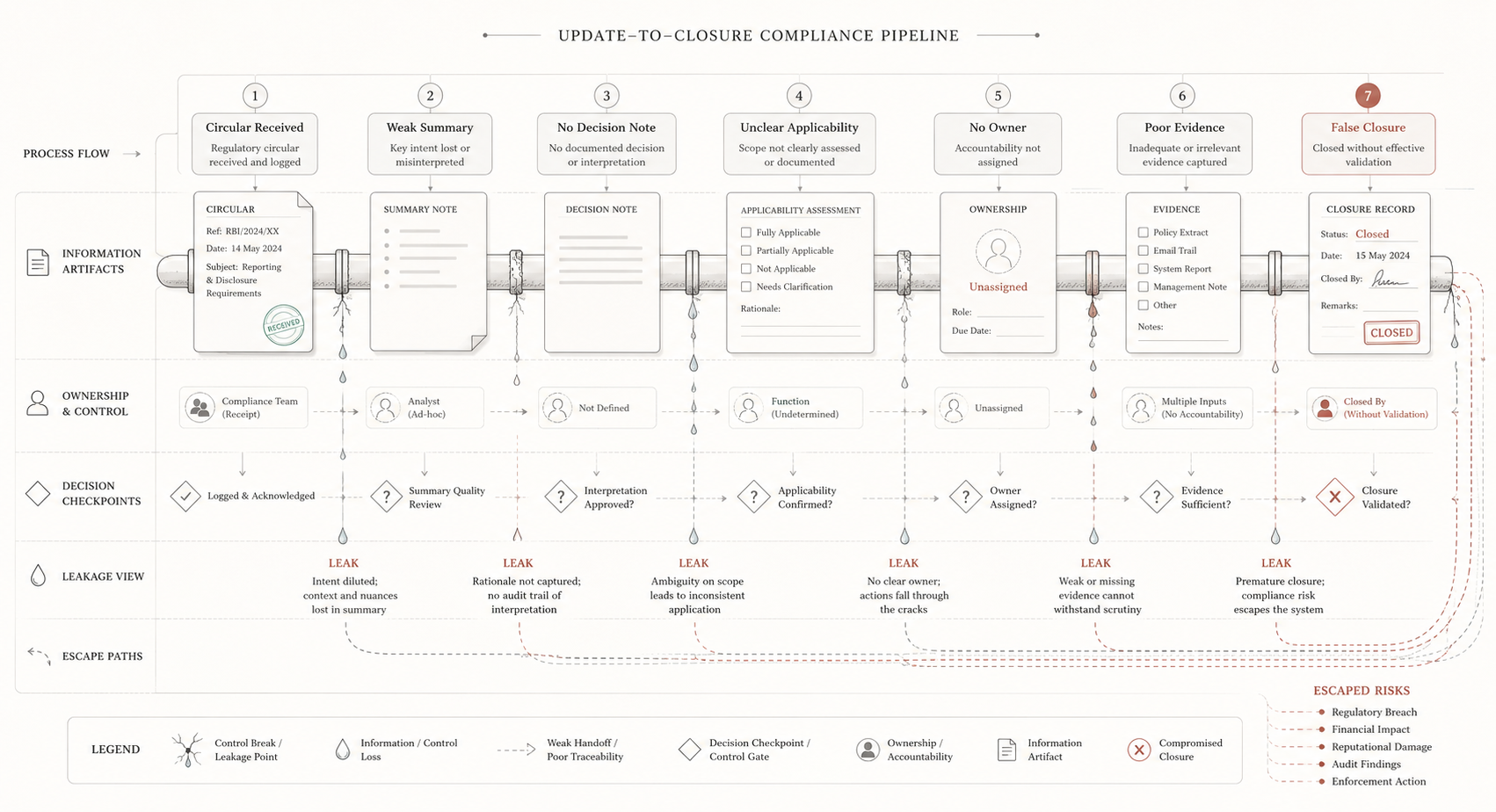
The first leak is the summary.
Many update logs contain summaries that are either too vague or too long. A vague summary says, “Circular regarding compliance requirements.” That tells nobody anything. A long pasted summary is not much better if it simply dumps the circular text without explaining the practical impact.
A useful summary should answer one question: what does this update change for us?
Not every circular needs a legal memo. But every important update needs a clear operational summary. Does it introduce a new obligation? Change a deadline? Modify a reporting format? Require system changes? Create a client communication requirement? Clarify an existing rule? Remove an old requirement?
If the summary cannot answer that, the log is only storing information, not creating understanding.
The second leak is the missing decision note.
This is one of the biggest weaknesses in compliance tracking. A circular is reviewed. Someone decides it is applicable, not applicable, partially applicable, or for monitoring only. But the reason is not written down.
Six months later, nobody remembers the logic.
That becomes dangerous during audits, inspections, internal reviews, or management escalation. A “not applicable” tag without reasoning is weak. A “completed” tag without a decision note is also weak. The firm should be able to show why a particular conclusion was reached at that time.
A decision note does not need to be complex. It can be short. But it should exist.
For example: “Not applicable because the circular applies only to clearing members; the entity is registered as a trading member and does not perform clearing activity.”
Or: “Applicable to RMS and IT because the circular requires changes to margin validation before order entry.”
That note is what turns a compliance opinion into a reviewable record.
The third leak is poor applicability reasoning.
Applicability is often treated like a checkbox. Applicable. Not applicable. Partially applicable.
But in real compliance work, applicability is rarely that simple. It may depend on registration category, business segment, services offered, client type, transaction model, exchange membership, depository role, technology setup, or threshold conditions.
If the firm does not capture the basis of applicability, the same question keeps returning. Operations asks again. IT asks again. Management asks again. New team members ask again. The compliance team wastes time explaining what the log should already show.
Worse, a weak applicability record can hide mistakes. An update may be wrongly marked not applicable because nobody checked the relevant business process. Or it may be marked applicable without identifying which team must act.
Applicability should always connect to the firm’s actual business. A circular does not become relevant merely because it is important. It becomes relevant because it touches a function, obligation, process, registration, client activity, or control inside the firm.
The fourth leak is no owner.
This is where many logs quietly fail. The status says “under review” or “in progress,” but no one is clearly responsible. A department name may be written, but not a person or role. Compliance assumes operations will handle it. Operations assumes compliance is only asking for comments. IT waits for specifications. Management assumes the matter is being tracked.
No owner means no accountability.
A proper update log should show one accountable owner for every action item. Supporting teams can be added, but ownership must be clear. If a circular requires IT change and compliance review, both may be involved, but the implementation task still needs a named owner or role.
This is especially important when deadlines are short. A circular can be correctly identified, correctly summarised, and correctly marked applicable — and still fail because nobody owns execution.
The fifth leak is status inflation.
This happens when firms use optimistic status labels. “Closed” means someone replied. “Completed” means a department said it was done. “Implemented” means the team believes it was handled. But nobody checked evidence.
Status should describe reality, not comfort.
There is a difference between assigned, in progress, pending confirmation, pending evidence, completed by owner, reviewed by compliance, and closed. If all these stages are collapsed into one “done” field, the system loses control.
A strong closure process should separate action completion from compliance closure. The business owner may complete the task, but compliance should verify whether the required evidence is available before final closure, especially for material updates.
The sixth leak is no final closure evidence.
This is the leak that hurts most during inspection.
A task was marked closed. But where is the proof? Was the report filed? Was the system updated? Was the client communication sent? Was the policy revised? Was the exchange submission uploaded? Was the board note placed? Was the training completed? Was the screenshot saved?
If the evidence is not attached, linked, or clearly referenced, closure is only a statement.
Evidence should be defined before closure, not hunted after the fact. For each action item, the system should say what proof is required. The type of evidence will vary: filing acknowledgement, system screenshot, approval email, revised SOP, meeting note, communication copy, vendor confirmation, training attendance, audit log, or management approval.
The seventh leak is losing the history of changes.
Compliance updates often evolve. A circular may be amended. A deadline may be extended. A clarification may arrive. Internal interpretation may change after discussion. Ownership may shift from one department to another.
If the log overwrites old information without preserving history, the firm loses context. Later, nobody can explain why a decision changed or when a task was reassigned.
A good system should preserve remarks, timestamps, status changes, owner changes, and evidence additions. This gives the firm a timeline, not just a final result.
The deeper problem is that many firms use update logs as administrative trackers. They should be using them as control records.
A control record should answer:
What came in?
What does it mean?
Does it apply?
Why does it apply or not apply?
Who owns the action?
What is the deadline?
What evidence is required?
Who verified closure?
Can we retrieve the trail later?
If these answers are missing, the firm does not have a reliable closure process. It has a list.
This is where a structured system makes a real difference. Not because software magically creates compliance discipline, but because it forces the right fields, the right decisions, and the right closure habits.
A proper compliance system should not allow important updates to disappear behind vague summaries, blank applicability reasoning, ownerless tasks, or evidence-free closure. It should make the leak visible before it becomes an audit issue.
For regulated firms, the goal is not to create a longer tracker. The goal is to create a better trail.
Because when the question comes later, “we had logged it” is not enough.
The real test is whether the log can prove that the firm understood the update, made a reasoned decision, assigned the work, completed the action, and preserved the evidence.
That is closure tracking done properly.
Related compliance hubs
Continue from this explainer into topic hubs that connect analysis with regulator updates and workflow context.
Related regulator archives
Continue into source-linked archives for regulators connected to this topic area.
Related articles
Continue with related analysis selected by the editorial team or sharing the same topics.
Related legal updates
Source-linked updates that place this article in the current regulatory workflow.
Content accountability
Prepared by CompliSense Editorial Desk (Regulatory Content Team) and reviewed by CompliSense Regulatory Review Desk (Compliance Review Team).
This attribution reflects the preparation and review roles used for CompliSense regulatory publishing.