How to Maintain a Proper Compliance Audit Trail for Regulatory Updates
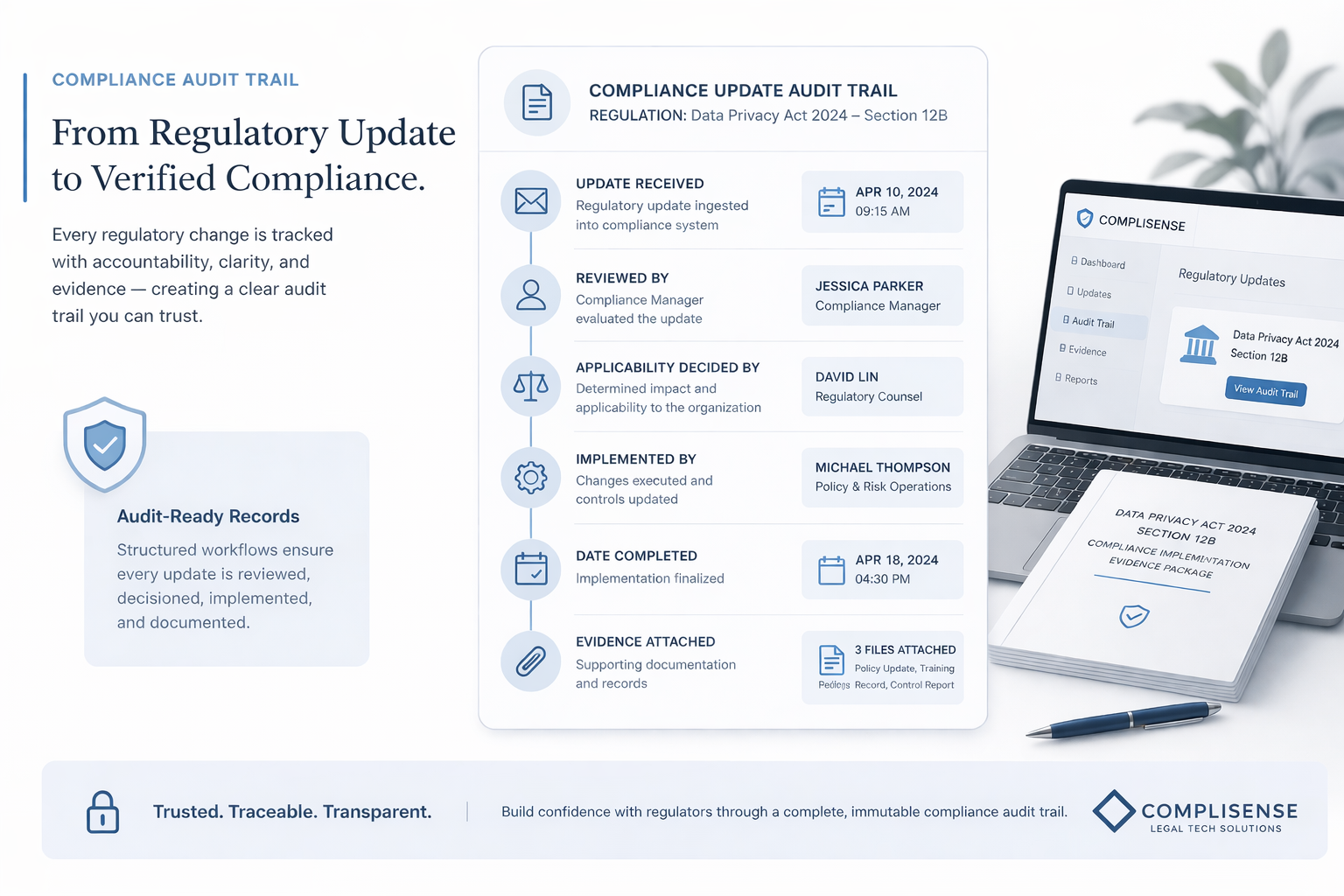
A compliance audit trail is not just a folder of circulars. It should show who reviewed the update, who decided applicability, who implemented the action, and where closure evidence sits. That structure matters when audits, inspections, or internal reviews begin.
- compliance audit trail
- regulatory updates
- compliance workflow
- audit readiness
- regulatory monitoring
- implementation evidence
A lot of compliance teams think they have an audit trail because they keep emails, circular PDFs, and a few trackers.
That is usually not an audit trail. That is stored activity.
The difference only becomes obvious when someone asks a hard question. Who reviewed this update first? Who decided it was applicable or not applicable? Who was responsible for implementing it? When was the action completed? Where is the evidence? And if the same issue came up again later, can the firm show a clean record of what was done without digging through old emails and half-maintained spreadsheets?
That is the test. A real compliance audit trail should let the firm answer those questions quickly and confidently. If it cannot, the process may feel active day to day but still be weak when scrutiny starts.
This is where many growing teams get caught. Their monitoring may be decent. Their people may be sincere and hardworking. Updates are being read, discussed, and forwarded. Someone usually knows what happened. But “someone knows” is not a control framework. It is a dependence on memory and informal coordination. That may survive routine days. It does not survive audits, inspections, escalations, or management review very well.
A proper compliance audit trail starts with a simple principle: every regulatory update should leave behind a structured record of the firm’s response, not just a copy of the update itself.
The first thing that must be recorded is who reviewed the update. This sounds obvious, but many firms do not capture it properly. An email being received in a shared inbox does not prove review. A forwarded message does not prove review either. A good audit trail should show which person first reviewed the update, and ideally when. That matters because review is the first internal control point. If the firm later needs to understand whether a delay happened at the monitoring stage or the implementation stage, this record becomes critical.
The second thing that must be recorded is who decided applicability. This is one of the most important parts of the trail. Regulatory updates do not all affect every entity in the same way. Some apply directly. Some apply only to certain segments, activities, or business models. Some need interpretation before a conclusion can be reached. If the applicability decision is not recorded clearly, the firm creates two problems for itself. First, it becomes harder to defend why an update was treated a certain way. Second, the same discussion often gets repeated later because the original reasoning is lost. A proper audit trail should show who made the applicability call, what conclusion was reached, and ideally the basis for that conclusion.
The third thing that must be recorded is who implemented the required action. This is where many informal systems break down. In practice, the people who review an update are not always the people who execute the response. A circular may be reviewed by compliance, but implemented by operations, technology, legal, or another business function. If the trail stops at “reviewed” or “noted,” it does not show whether the firm actually acted. A strong audit trail makes ownership visible. It should show who was assigned the action, what they were expected to do, and whether they completed it.
The fourth thing that must be recorded is when the action moved and when it was completed. Time matters in compliance. It is not enough to know that something was eventually done. During an audit or inspection, timing can become part of the story. Was the update picked up promptly? Was applicability assessed quickly? Was implementation completed before the effective date or internal deadline? A proper audit trail should preserve those timestamps so the firm can demonstrate responsiveness, not just eventual awareness.
The fifth thing that must be recorded is where the evidence sits. This is where inboxes and informal spreadsheets fail badly. They may help teams note that an action was done, but they rarely give a reliable, structured place for closure evidence. Evidence might include a process note, policy revision, internal approval, maker-checker confirmation, screenshot, system change record, closure memo, or meeting note. If that proof is scattered across folders, personal mailboxes, chat messages, or unlinked documents, retrieval becomes painful at exactly the moment the firm needs clarity. A proper audit trail should not merely say “completed.” It should point to the evidence that supports completion.
This is why informal spreadsheets create false comfort. They look organized because rows exist and statuses are updated. But during real scrutiny, their weakness becomes obvious. A spreadsheet may say an item was reviewed or completed, but it often cannot show who truly made the decision, what basis was used, whether the action was assigned formally, or where the supporting evidence can be found. In other words, the spreadsheet may record progress, but not defensibility.
Inboxes fail for a different reason. They are built for communication, not controlled recordkeeping. Emails can show that someone received a circular or forwarded it, but they do not naturally create a clean workflow. Threads split. Replies get lost. Attachments sit in different places. Ownership is implied rather than recorded. Search works only if someone already knows what they are looking for. When an audit or inspection starts, relying on mailbox archaeology is a terrible operating model.
A proper compliance audit trail needs structure. At a minimum, for each update, the record should answer these questions in one place: what was the update, who reviewed it, what applicability decision was made, who made that decision, who owned implementation, what was the status, when was it completed, and where is the proof. That is the difference between a process that can be explained and one that can be defended.
This also matters internally, not just during external review. Management cannot oversee compliance operations properly if it only sees a stream of updates and broad status labels. A strong audit trail helps leaders identify where work is getting delayed. Is the bottleneck in review? Is applicability assessment taking too long? Are actions not being assigned properly? Is evidence collection weak? Without structured records, all of that becomes guesswork.
The real point here is simple. A compliance team should not have to reconstruct history each time a question is raised. It should be able to retrieve it.
That is what an audit trail is for. It is not a dump of circulars. It is not a folder of PDFs. It is not a spreadsheet with green and red cells. It is a structured record of regulatory response.
When firms understand that, their entire compliance workflow improves. Review becomes more deliberate. Applicability decisions become more consistent. Ownership becomes clearer. Closure becomes stronger. And when the inevitable audit, inspection, or internal escalation arrives, the team is not forced into a scramble to prove what happened.
They can show it.
Related compliance hubs
Continue from this explainer into topic hubs that connect analysis with regulator updates and workflow context.
Related regulator archives
Continue into source-linked archives for regulators connected to this topic area.
Related articles
Continue with related analysis selected by the editorial team or sharing the same topics.
Related legal updates
Source-linked updates that place this article in the current regulatory workflow.
Content accountability
Prepared by CompliSense Editorial Desk (Regulatory Content Team).
This attribution reflects the preparation role used for CompliSense regulatory publishing.