How to Prioritize Which Regulatory Updates Need Immediate Action
Not every regulatory update deserves a fire drill. Brokers and intermediaries need a practical urgency score based on deadline, business impact, reporting consequence, system impact, and stakeholder visibility.
- regulatory updates
- compliance prioritization
- stock broker compliance
- compliance urgency score
- sebi circulars
- compliance workflow
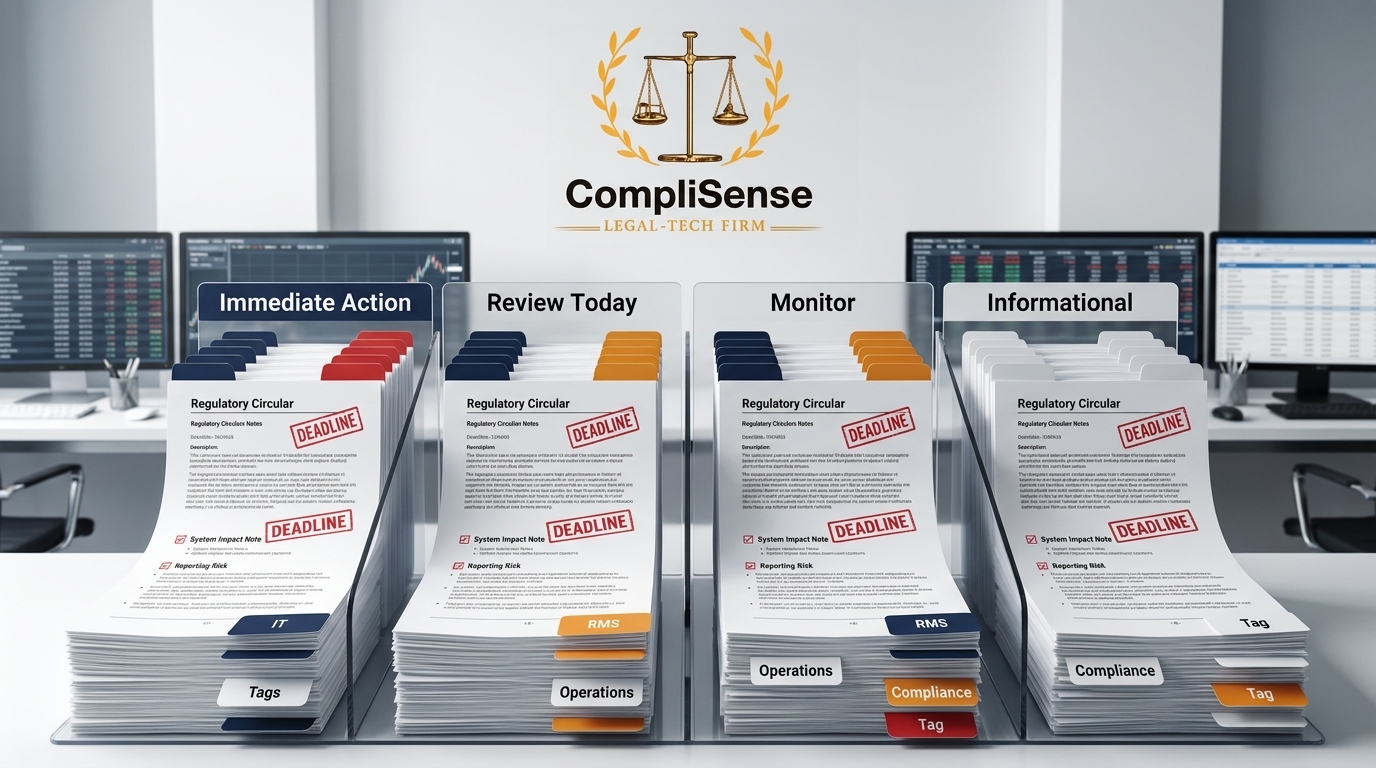
The fastest way to weaken a compliance team is to treat every regulatory update as equally urgent.
If every circular becomes a fire drill, people stop reacting properly. Operations gets flooded. IT starts asking which items are actually critical. Senior management receives too many “important” emails. Compliance spends the day forwarding updates instead of deciding what needs action.
But the opposite problem is just as dangerous. A circular that looks routine may carry a same-day implementation requirement. An exchange notice may trigger a system change. A reporting update may create a penalty risk if missed. A small operational instruction may affect client communication, trading access, settlement, margin, or surveillance.
So the real question is not: “Did we receive the update?”
The real question is: “How quickly does this need to move?”
That requires a prioritization method.
For brokers, DPs, and other market intermediaries, regulatory updates come from too many places to rely on instinct alone. SEBI, exchanges, depositories, RBI, IFSCA, and other authorities may all issue updates with different levels of urgency. Some require immediate action. Some need internal awareness. Some need legal interpretation. Some require only monitoring.
A practical compliance team should have a simple urgency score for every important update.
Not a complicated risk model. Not a 20-column spreadsheet nobody uses. A clear scoring method that helps the team decide what should be escalated now, what should be reviewed today, what can be tracked this week, and what is informational.
A strong urgency score can be built around five factors.
1. Deadline pressure
The first question is the most obvious: when does this need to be done?
An update with a same-day or next-day effective date deserves a different response from one with a 30-day implementation window. But teams often miss this because they read the subject line, not the effective date.
Every regulatory update should be checked for:
Immediate effective date
Specific submission deadline
Implementation timeline
Board or management approval requirement
Transition period
Penalty or consequence for delay
Deadline pressure should be scored high where action is required within hours or days, especially if multiple teams are involved.
The mistake to avoid is assuming that “issued today” means “action later.” Some updates are backdated. Some are effective immediately. Some require confirmation before the next trading day. The effective date matters more than the reading date.
2. Business impact
The second question is: what part of the business does this affect?
A circular affecting a rarely used process may be lower urgency. A circular affecting trading, client onboarding, margin, settlement, DP operations, surveillance, investor grievances, cyber security, or regulatory reporting needs faster attention.
Business impact is high when the update affects live operations.
For a broker, this may include trading systems, RMS controls, order handling, client communication, exchange reporting, pledge/re-pledge processes, margin collection, KYC, surveillance alerts, or back-office processing.
For a DP, it may affect account opening, freeze/unfreeze processes, demat transactions, client instructions, pledge operations, nomination, transmission, DIS handling, or reporting to depositories.
The test is simple: if the update is missed, will any business process run incorrectly?
If yes, it needs priority.
3. Reporting consequence
Some updates may not look operationally dramatic, but they carry reporting consequences. These are dangerous because they can be missed quietly.
A filing format change, revised reporting field, new submission timeline, certificate requirement, audit confirmation, exchange upload, or periodic disclosure may not create visible business disruption. But if missed, it can create regulatory observations, fines, inspection comments, or repeated non-compliance.
Reporting consequence should be scored high where the update affects:
Regulatory submissions
Exchange or depository filings
Periodic reports
System-generated reports
Board or committee reporting
Audit certificates
Inspection responses
Client-level disclosures
These updates need special attention because the failure is often discovered after the deadline has passed.
A good compliance team should ask: does this update create or modify something we must submit, certify, upload, preserve, or disclose?
If yes, it should not sit in a general reading folder.
4. System impact
This is where many firms underestimate urgency.
If an update requires a system change, workflow change, report change, access control update, validation change, alert configuration, or data capture change, it must be identified early. IT and product teams cannot be expected to implement regulatory changes at the last minute because compliance noticed the system impact too late.
System impact should be scored high when the update affects:
Trading platforms
Back-office systems
RMS engines
Client portals
Reporting utilities
DP software
Surveillance systems
Email/SMS templates
Maker-checker workflows
Audit logs
Data fields or exports
Even a small regulatory change can become urgent if it needs development, testing, deployment, vendor coordination, or exchange/depository confirmation.
The practical question is: can this be implemented by compliance alone?
If the answer is no, the update needs earlier escalation.
5. Stakeholder visibility
Some updates require attention because many people need to know.
This may include senior management, board members, compliance committees, branch teams, dealers, client-facing teams, vendors, auditors, investors, or clients. The more visible the impact, the more disciplined the communication needs to be.
Stakeholder visibility is high when the update affects client communication, management assurance, public disclosure, board oversight, regulator-facing explanation, or multiple departments.
These updates should not be handled through a casual forward. They need a communication plan.
Who must be informed?
Who must approve the internal response?
Who must act?
Who may ask questions later?
What should be documented?
This factor matters because regulatory implementation is not only about doing the work. It is also about making sure the right people know what is changing.
A simple urgency score
A practical scoring model can use a 1 to 5 score for each factor:
Deadline pressure
Business impact
Reporting consequence
System impact
Stakeholder visibility
The total score gives a quick action category.
A score of 20–25 should be treated as immediate action. These updates need same-day review, owner assignment, escalation, and close monitoring.
A score of 14–19 should be reviewed today. These may not be emergencies, but they need clear ownership and timeline tracking.
A score of 8–13 can be tracked as normal priority. These should be logged, reviewed, and assigned if applicable.
A score below 8 may be informational, unless legal interpretation suggests otherwise.
This is not a substitute for compliance judgment. It is a way to make judgment consistent.
The benefit is speed with discipline. Instead of arguing over whether something is “important,” the team has a common language. A circular with short deadline, high reporting consequence, and system impact moves to the top. A general awareness update does not distract everyone.
Senior management also benefits because escalation becomes cleaner. Instead of receiving every update, they receive the right updates with the right reason: high deadline pressure, high business impact, system change required, reporting consequence, or stakeholder visibility.
The most useful compliance teams are not the ones that panic fastest. They are the ones that triage correctly.
For market intermediaries, this matters because regulatory volume is not the only problem. The bigger problem is uneven attention. Some updates are over-discussed. Some are under-reviewed. Some are forwarded but not owned. Some are noticed only when the deadline is close.
A scoring model reduces that randomness.
The best time to prioritize a regulatory update is when it is first reviewed. Not after three follow-up emails. Not after IT says it needs more time. Not after management asks for status. Not after the deadline is already uncomfortable.
Every update should enter the system with a basic answer:
How urgent is this, and why?
That one question can prevent a lot of avoidable compliance stress.
Related compliance hubs
Continue from this explainer into topic hubs that connect analysis with regulator updates and workflow context.
Related regulator archives
Continue into source-linked archives for regulators connected to this topic area.
Relevant CompliSense capabilities
These capabilities support the operating pattern discussed in this article.
Related articles
Continue with related analysis selected by the editorial team or sharing the same topics.
Related legal updates
Source-linked updates that place this article in the current regulatory workflow.
Content accountability
Prepared by CompliSense Editorial Desk (Regulatory Content Team) and reviewed by CompliSense Regulatory Review Desk (Compliance Review Team).
This attribution reflects the preparation and review roles used for CompliSense regulatory publishing.