Historical Search of Circulars: Why It Matters During Audits, Reviews, and Internal Escalations
Historical circular search is not a convenience feature. During audits, inspections, management queries, and repeat internal questions, fast retrieval can decide how confidently a firm responds.
- historical circular search
- regulatory archive
- compliance archive
- audit readiness
- stock broker compliance
- regulatory updates
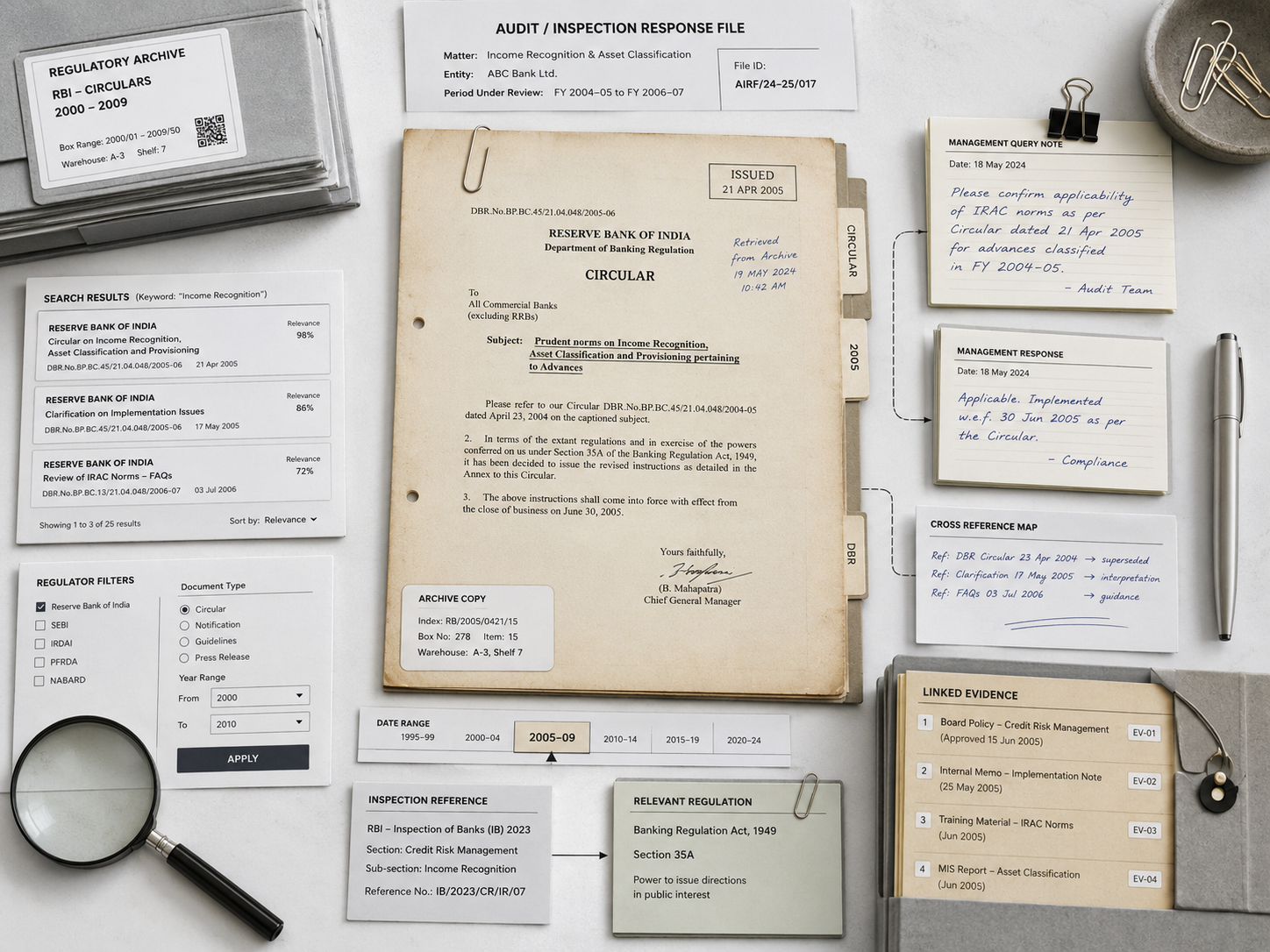
The most uncomfortable compliance questions rarely arrive on the day a circular is issued.
They arrive six months later.
An auditor asks, “What was the regulatory basis for this control?”
A senior manager asks, “When did this requirement first come in?”
An inspection team asks for the circular behind a process change.
Operations asks why a particular reporting field was added.
A new compliance officer asks whether an old instruction is still relevant.
Someone remembers that “there was a circular,” but nobody remembers the date, number, regulator, or exact wording.
That is when historical search matters.
Most firms focus heavily on receiving regulatory updates. That is necessary. But receiving updates is only the first layer. The second layer is being able to retrieve the right update later, quickly and confidently, when the business actually needs it.
Without a proper archive, compliance teams fall back on inbox searches, old WhatsApp messages, shared drives, personal folders, downloaded PDFs, and memory. Sometimes the circular is found. Sometimes an outdated version is used. Sometimes teams rely on a forwarded summary rather than the original document. Sometimes the person who knew the answer has left.
This is not just inconvenient. It is a control weakness.
A regulatory archive should not be treated as a digital cupboard. It should function like institutional memory.
During audits and inspections, historical retrieval becomes especially important. Auditors do not always ask only whether an action was completed. They may ask why the action existed in the first place. They may want to see the circular, notification, exchange notice, depository communication, or regulator direction that triggered the internal process.
If the team can retrieve the exact source within minutes, the response feels controlled. If the team spends hours searching emails and folders, the response feels fragile.
That difference matters.
A searchable archive helps the compliance team answer basic but critical questions:
What was the circular?
Which regulator issued it?
When was it issued?
What was the effective date?
Was it later amended or superseded?
Did we mark it as applicable?
What internal action did we take?
Where is the evidence?
These questions should not require detective work.
Historical search is also valuable for recurring internal questions. In regulated businesses, the same issues come back again and again. A department asks whether a process is mandatory. A branch asks whether a particular client communication is required. IT asks why a field exists in a report. Operations questions whether an old control still applies. Senior management wants the background to a recurring compliance cost.
If the compliance team has to rediscover the answer every time, time is wasted. Worse, answers may become inconsistent.
A good archive allows the team to respond from the original source, not from vague recollection. This improves consistency. It also reduces dependence on senior team members who “remember everything.”
For stock brokers, DPs, and market intermediaries, this is particularly important because regulatory instructions are often operational. A circular may affect trading procedures, risk management, settlements, KYC, DP processes, pledge workflows, cyber controls, investor grievances, reporting formats, or inspection preparation. Months later, the circular may still explain why a particular internal process exists.
If the source cannot be found, the process starts looking arbitrary.
Historical retrieval also matters during internal escalations. When a matter reaches senior management, the question is often not only “what should we do?” It is “how serious is this, and what is the regulatory basis?”
A strong archive helps compliance present the issue clearly. Instead of saying, “This was required under an old exchange circular,” the team can show the circular, the relevant date, the affected obligation, the earlier internal decision, and the current open issue.
That changes the quality of the discussion.
Management does not need a long lecture. It needs the right context. Historical search gives that context fast.
There is also a defensibility angle. Compliance work is not only about doing the right thing. It is also about being able to show how the firm understood and responded to regulatory requirements at the relevant time.
This becomes important when rules change. A circular may be modified. A reporting requirement may be replaced. An exchange may change a format. A regulator may clarify an earlier position. If the firm cannot see the historical sequence, it may struggle to explain why a decision was reasonable when made.
A proper archive should therefore preserve chronology. It should help teams see what existed then, what changed later, and what internal action followed.
This is why a basic folder of PDFs is not enough.
A useful regulatory archive should be searchable by regulator, date, circular number, subject, keyword, business area, obligation type, applicability, and status. It should allow teams to filter by source and retrieve old items without knowing the exact title. It should also preserve links between the circular and the internal compliance response.
The best archive is not just “find the PDF.” It is “find the regulatory history and the firm’s response.”
For example, when searching an old circular, the team should ideally be able to see whether it was marked applicable, who reviewed it, what action was created, what department was involved, what evidence was stored, and whether there were later related updates.
That turns the archive from a document repository into a compliance intelligence layer.
It also helps new team members. Every compliance team eventually faces handover pressure. People move roles, resign, go on leave, or join midway through a regulatory cycle. A searchable archive gives new team members a way to understand past decisions without depending entirely on oral explanation.
This reduces institutional fragility.
The compliance head should not have to explain the same regulatory history repeatedly. The archive should carry that history.
For senior management, the value is simple: faster answers, cleaner escalation, better audit response, and less dependence on individual memory. For compliance teams, it means fewer hours wasted searching. For operations and IT, it means clearer regulatory context. For auditors and inspectors, it means the firm can show a more disciplined trail.
The practical test is this:
If someone asks for the circular behind a control implemented eight months ago, can your team find it in five minutes?
Not the forwarded email.
Not a summary.
Not a PDF someone saved locally.
The actual regulatory source, with context and internal response.
If the answer is no, the firm has an archive problem.
Regulatory monitoring is about knowing what changed. Historical search is about proving what was known, when it was known, and how the organisation responded.
Both are necessary.
A firm that only tracks today’s updates will remain reactive. A firm that can search its regulatory history becomes more confident, more consistent, and more defensible.
That is why the archive layer matters.
Related compliance hubs
Continue from this explainer into topic hubs that connect analysis with regulator updates and workflow context.
Related regulator archives
Continue into source-linked archives for regulators connected to this topic area.
Related articles
Continue with related analysis selected by the editorial team or sharing the same topics.
Related legal updates
Source-linked updates that place this article in the current regulatory workflow.
Content accountability
Prepared by CompliSense Editorial Desk (Regulatory Content Team) and reviewed by CompliSense Regulatory Review Desk (Compliance Review Team).
This attribution reflects the preparation and review roles used for CompliSense regulatory publishing.