From Update Received to Update Implemented: A Practical Compliance Workflow
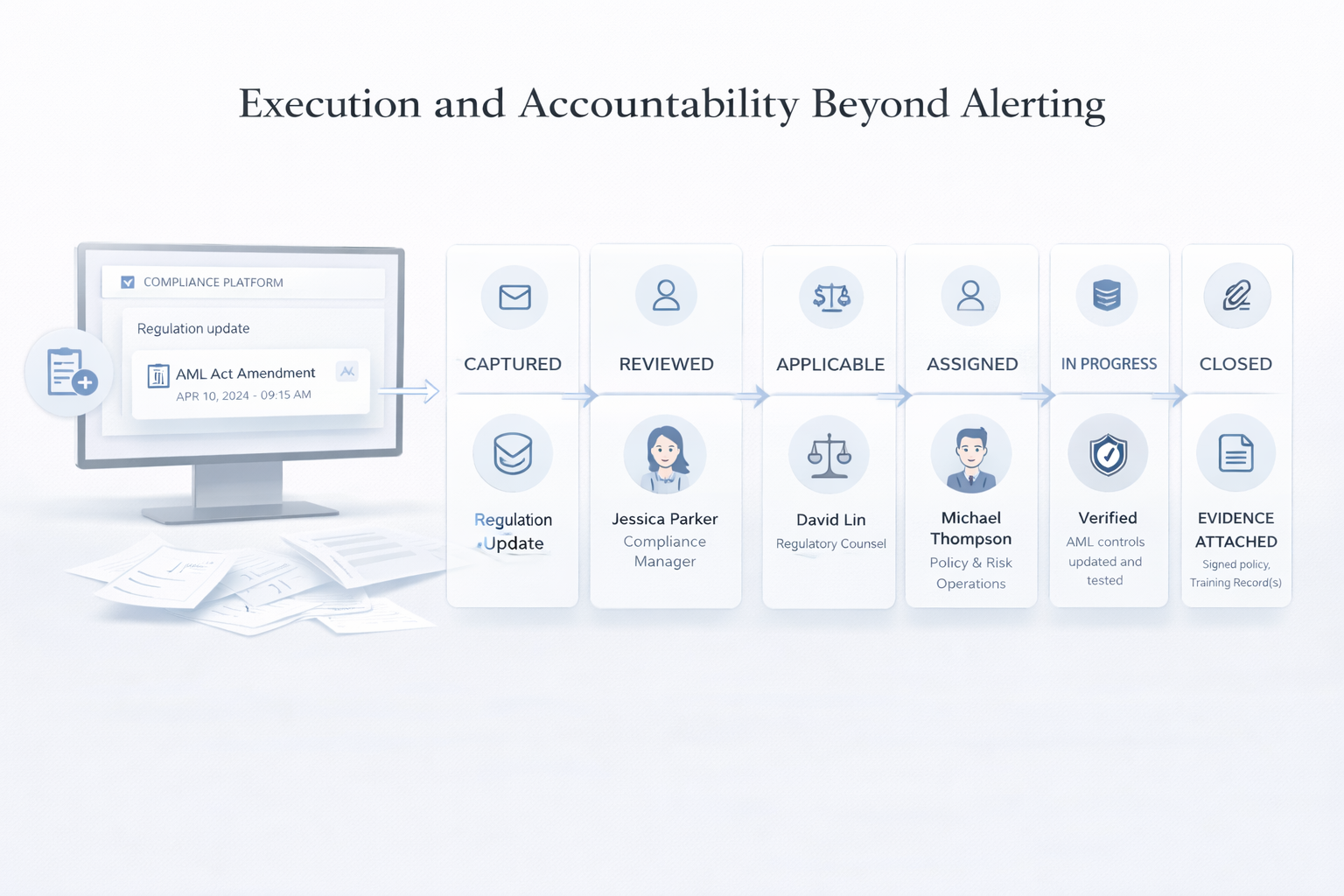
A regulatory update is only the starting point. A practical compliance workflow should capture, summarize, classify, assign, implement, verify, and close each update with evidence. That is how firms move from awareness to actual control.
- compliance workflow
- regulatory updates
- implementation tracking
- compliance operations
- audit trail
- regulatory monitoring
Many firms still treat regulatory monitoring as if the hard part ends once the update is received.
A circular comes in. Someone reads it. Maybe a summary is shared internally. Maybe it is forwarded to the relevant team. At that point, everyone feels like the process is moving. But that is exactly where weak compliance workflows create false comfort. Receiving an update is not the same as implementing it. Awareness is only the front end. Control is what happens after.
That distinction matters because most compliance failures do not happen at the point of receipt. They happen in the space between “we saw it” and “we actually did what was required.” That middle layer is where updates get lost, ownership becomes blurry, action sits pending, and proof of completion goes missing.
A practical compliance workflow should close that gap. It should take an update from arrival to implementation in a structured, reviewable way. At a minimum, that lifecycle should include seven stages: capture, summarize, classify, assign, implement, verify, and close.
The first stage is capture.
This is where the update enters the firm’s system. Not someone’s personal inbox. Not a WhatsApp message. Not an isolated spreadsheet row. A real workflow begins when the update is captured into one controlled record. That record should show the source, regulator or issuing authority, and the date and time captured. This matters more than teams think. If updates are not captured properly, everything after that becomes fragile. You cannot supervise well if the entry point itself is scattered.
The second stage is summarize.
Raw circular titles are rarely enough. A practical workflow needs a short internal summary that explains what changed, who may be affected, and what kind of action might be required. This is where regulatory information starts becoming usable intelligence. A good summary reduces confusion and speeds up internal triage. A bad or missing summary forces every stakeholder to reopen the source document from scratch, which slows the process and creates inconsistent understanding.
The third stage is classify.
This is one of the most important parts of the lifecycle. Every update should be classified for applicability, urgency, and type of action required. Does it apply fully, partly, or not at all? Is it immediate, near-term, or only relevant for future planning? Is the response operational, legal, reporting-related, process-related, or system-related? Without classification, all updates start looking equally important and equally undefined. That creates noise, not control. Classification is what gives the workflow direction.
The fourth stage is assign.
This is where many firms quietly fail. They believe forwarding equals ownership. It does not. A practical workflow should clearly identify who owns the next step. That may be compliance, operations, legal, risk, technology, or another business function. But it should be explicit. The owner should know the task, the deadline, and the expected output. Without assignment, the update remains visible but unmanaged. Everyone may know about it, yet nobody may be accountable for moving it.
The fifth stage is implement.
This is the stage that separates a notification system from a real compliance operating process. Implementation means the required action is actually taken. A procedure is updated. A system setting is changed. An internal control is revised. A disclosure step is completed. A business process is adjusted. Whatever the update requires, this is where the firm turns interpretation into execution. Many compliance setups are decent at reading and discussing updates but weak at translating them into tracked action. That is exactly why implementation needs its own stage, not just an implied assumption.
The sixth stage is verify.
Implementation should not be treated as self-certified. A proper workflow needs a verification step. Was the required action actually completed? Was it completed correctly? Was the deadline met? Is the applicability conclusion still valid in light of what was done? Verification matters because it prevents the workflow from closing too early based on assumption or incomplete follow-through. In practice, this may involve a reviewer, a compliance check, a maker-checker step, or some other confirmation method depending on the nature of the update.
The seventh stage is close.
Closure should mean more than changing a status label to completed. A strong compliance workflow closes an update only when the record is complete. That means the final status is updated, the implementation outcome is clear, and the supporting evidence is attached or linked properly. Evidence may include an internal note, approval mail, revised document, screenshot, system log, meeting record, or closure memo. Without that evidence layer, closure is weak. The update may appear complete, but the firm may still struggle to defend what was done later.
This is the practical workflow many teams need but do not yet have.
Instead, they often run a patchwork version of it across email, chat, spreadsheets, folders, and memory. Capture happens in one place. Summary happens in a call. Classification happens in someone’s head. Assignment happens in a forwarded mail. Implementation happens in another team. Verification is informal. Closure is assumed. That kind of workflow may function for a while, especially in smaller environments with experienced people. But it does not scale well, it is hard to supervise, and it becomes painful during audits or inspections.
That is why the real value is not in “getting updates.”
Plenty of firms already get updates. They receive alerts, notifications, circular emails, and website changes. That is not the differentiator anymore. The real differentiator is whether the firm has a workflow that takes those updates all the way to controlled implementation.
That is also where the commercial gap becomes obvious. Basic update services help teams know that something happened. A stronger compliance system helps teams decide what it means, who owns it, what action is needed, whether it was done, and how to prove it later. That is not a small improvement. That is a completely different operating model.
Firms that want better control should look at their current process honestly. When an update comes in today, can the team see all seven stages clearly? Can they track where the item sits right now? Can they identify the owner, the deadline, the verification step, and the evidence? Or are they still depending on follow-up mails, side trackers, and personal memory?
That is the real test.
Because in compliance, being informed is useful. But being able to move from update received to update implemented in a structured, defensible way is what actually reduces risk.
Related compliance hubs
Continue from this explainer into topic hubs that connect analysis with regulator updates and workflow context.
Related regulator archives
Continue into source-linked archives for regulators connected to this topic area.
Related articles
Continue with related analysis selected by the editorial team or sharing the same topics.
Related legal updates
Source-linked updates that place this article in the current regulatory workflow.
Content accountability
Prepared by CompliSense Editorial Desk (Regulatory Content Team).
This attribution reflects the preparation role used for CompliSense regulatory publishing.