What Senior Management Should Actually Expect From a Modern Compliance Monitoring System
A modern compliance monitoring system should give senior management visibility, accountability, timelines, evidence, and audit-readiness — not just alerts or scattered status updates.
- compliance monitoring
- senior management
- compliance software
- audit readiness
- regulatory tracking
- governance
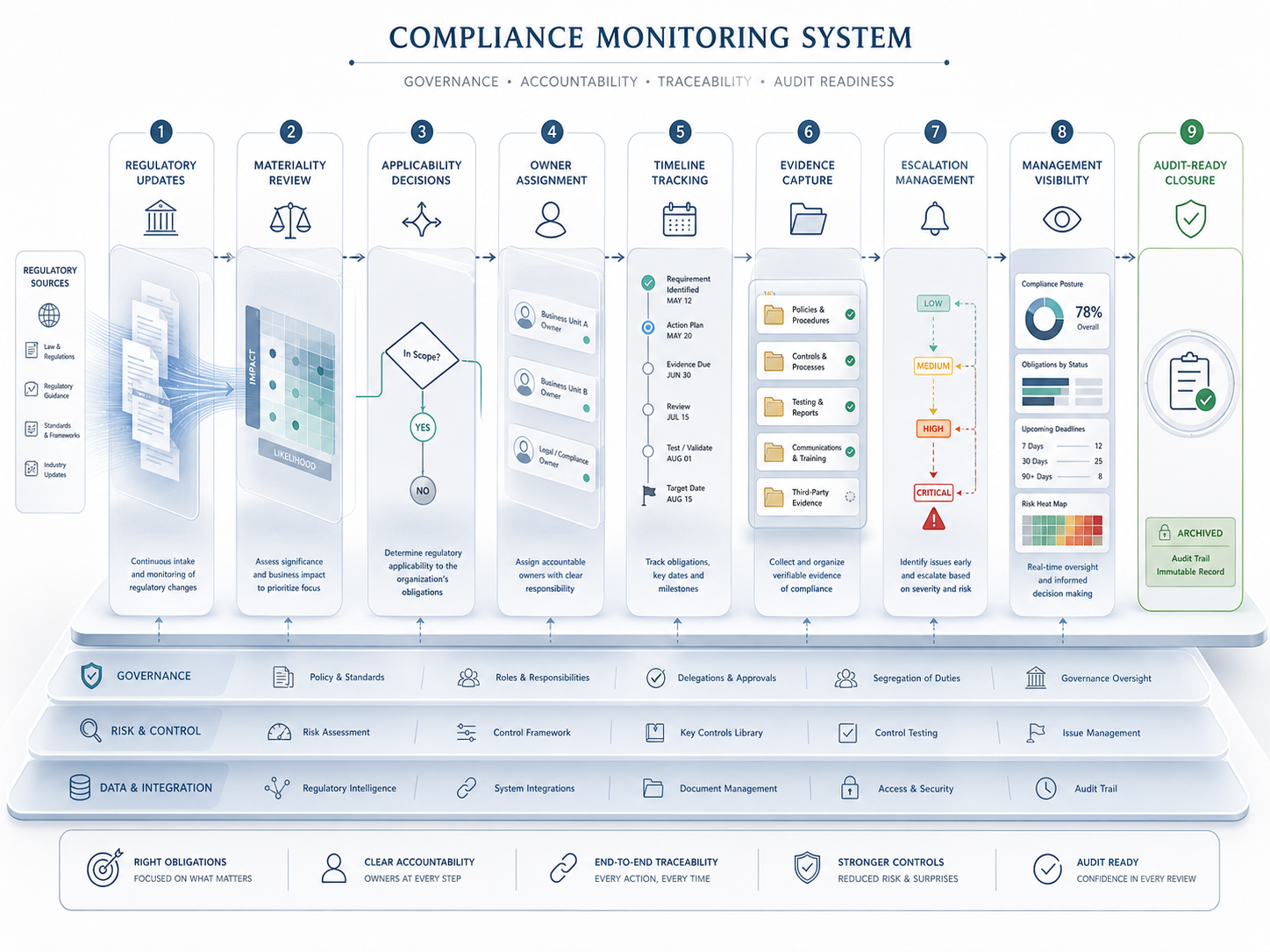
The shift senior management should look for is simple: from compliance as a department activity to compliance as an operating control.
That means regulatory updates are not just read. They are assessed. Applicable items are not just forwarded. They are assigned. Tasks are not just discussed. They are tracked. Closure is not just assumed. It is evidenced. Management is not dependent on verbal comfort. It has visibility.
A modern compliance monitoring system should give senior management confidence without creating blind trust. It should make risk visible, ownership clear, delays traceable, and evidence accessible.
That is what serious oversight looks like.In a well-run compliance function, senior management should not need to ask, “Is anything pending?”
They should already be able to see it.
That is the real promise of a modern compliance monitoring system. It is not just a place where circulars are uploaded. It is not merely an alert tool. It is not an online version of an Excel tracker. For founders, directors, and senior managers, a good compliance system should answer a more important question: are we in control?
Many regulated businesses still treat compliance monitoring as something that sits inside the compliance department. The team receives circulars, reviews them, follows up with departments, stores evidence, and reports important items upward when required. This may work when volumes are low, responsibilities are simple, and timelines are flexible.
But that is not the reality for stock brokers, DPs, and other market intermediaries. Regulatory updates come from multiple sources. Implementation may involve operations, RMS, IT, accounts, KYC, DP operations, HR, finance, legal, and senior leadership. Some matters require immediate action. Some require system changes. Some require evidence. Some need board or committee visibility. Some look harmless at first but create risk later because nobody clearly owned them.
This is why senior management should stop asking only whether the firm “has a compliance system.” The better question is whether the system gives management visibility, accountability, timelines, evidence, and audit-readiness.
Visibility is the first expectation.
A modern compliance monitoring system should show what regulatory updates were received, what has been reviewed, what applies to the firm, what does not apply, and what still needs assessment. Senior management should not have to depend on weekly verbal updates or emergency emails to know whether important matters are open.
Visibility also means seeing risk in context. A long list of circulars is not useful by itself. Management needs to know which items are material, which ones are urgent, which ones affect client-facing processes, which ones require technology change, and which ones are pending with specific departments.
Without this, compliance becomes a black box. Management only sees the issue when it becomes urgent.
Accountability is the second expectation.
Every applicable compliance action should have an owner. Not a vague department. Not “operations to check.” Not “team to confirm.” One accountable owner should be visible, with supporting teams tagged where needed.
This matters because many compliance failures happen in the gap between awareness and action. Everyone knows a circular came. Everyone knows something may need to be done. But no one has clearly accepted responsibility for completing the action and providing evidence.
A modern system should remove that ambiguity. It should show who owns the task, when it was assigned, what is expected, who is supporting, what comments were added, whether the owner has updated the status, and whether escalation is needed.
Senior management should expect this level of clarity. If ownership is not visible, accountability is not real.
Timelines are the third expectation.
Compliance work is deadline-driven. Effective dates, submission dates, exchange timelines, inspection responses, client communication deadlines, internal review cycles, and implementation cut-offs all matter. A compliance monitoring system should not merely store tasks. It should make timelines visible and difficult to ignore.
Management should be able to see what is due today, what is overdue, what is coming up, and what is blocked. More importantly, the system should show whether delays are isolated or recurring. If the same department keeps delaying evidence, that is not just a compliance issue. It is an operational governance issue.
This is where a modern system becomes useful for founders and senior managers. It helps them see patterns. Which teams respond quickly? Which tasks get stuck? Which kinds of obligations create repeated delays? Which matters need earlier escalation?
A good system does not only record delay. It helps management prevent repeat delay.
Evidence is the fourth expectation.
A compliance task should not be treated as closed simply because someone said, “Done.” Senior management should expect evidence-linked closure. That means every completed action should have proof attached or referenced.
Evidence may include system screenshots, exchange submissions, depository filings, approval emails, revised policies, client communications, board or committee notes, training records, maker-checker logs, internal approvals, or compliance certificates. The exact evidence will depend on the obligation. But the principle is the same: closure should be defensible.
This matters because regulatory inspections and audits do not run on internal confidence. They run on records. If the firm cannot show what was done, when it was done, who approved it, and what evidence supports it, then the compliance position becomes weak.
Senior management should expect the system to make evidence part of the workflow, not an afterthought.
Audit-readiness is the fifth expectation.
Audit-readiness does not mean preparing files only when an inspection notice arrives. It means the system is already creating a trail as work happens. Every regulatory update should have a history: when it came in, who reviewed it, whether it was applicable, who owned it, what actions were taken, what evidence was uploaded, who reviewed closure, and whether anything was escalated.
This is not only useful for external inspections. It also helps internal reviews, board reporting, compliance committee discussions, management assurance, and handovers. When people leave, change roles, or go on leave, the record remains. The institution does not lose knowledge because one employee is unavailable.
That is what senior management should want: institutional control, not person-dependent compliance.
A modern compliance monitoring system should also improve communication between teams. Compliance should not have to chase every action manually through email and calls. Departments should have clear tasks. Owners should know their deadlines. Compliance should be able to see progress. Management should see exceptions.
This creates a healthier operating model. Compliance is not forced to act as a memory bank. Business and operations teams cannot hide behind vague follow-ups. Senior management does not have to intervene in every small matter. Escalation becomes targeted.
For founders, this matters because compliance risk is business risk. A missed obligation can affect reputation, regulatory standing, client trust, operational continuity, and management bandwidth. Even where there is no immediate penalty, weak compliance processes consume time and create uncertainty.
Related compliance hubs
Continue from this explainer into topic hubs that connect analysis with regulator updates and workflow context.
Related regulator archives
Continue into source-linked archives for regulators connected to this topic area.
Related articles
Continue with related analysis selected by the editorial team or sharing the same topics.
Related legal updates
Source-linked updates that place this article in the current regulatory workflow.
Content accountability
Prepared by CompliSense Editorial Desk (Regulatory Content Team) and reviewed by CompliSense Regulatory Review Desk (Compliance Review Team).
This attribution reflects the preparation and review roles used for CompliSense regulatory publishing.