SEBI Compliance Themes to Watch Going Into 2025
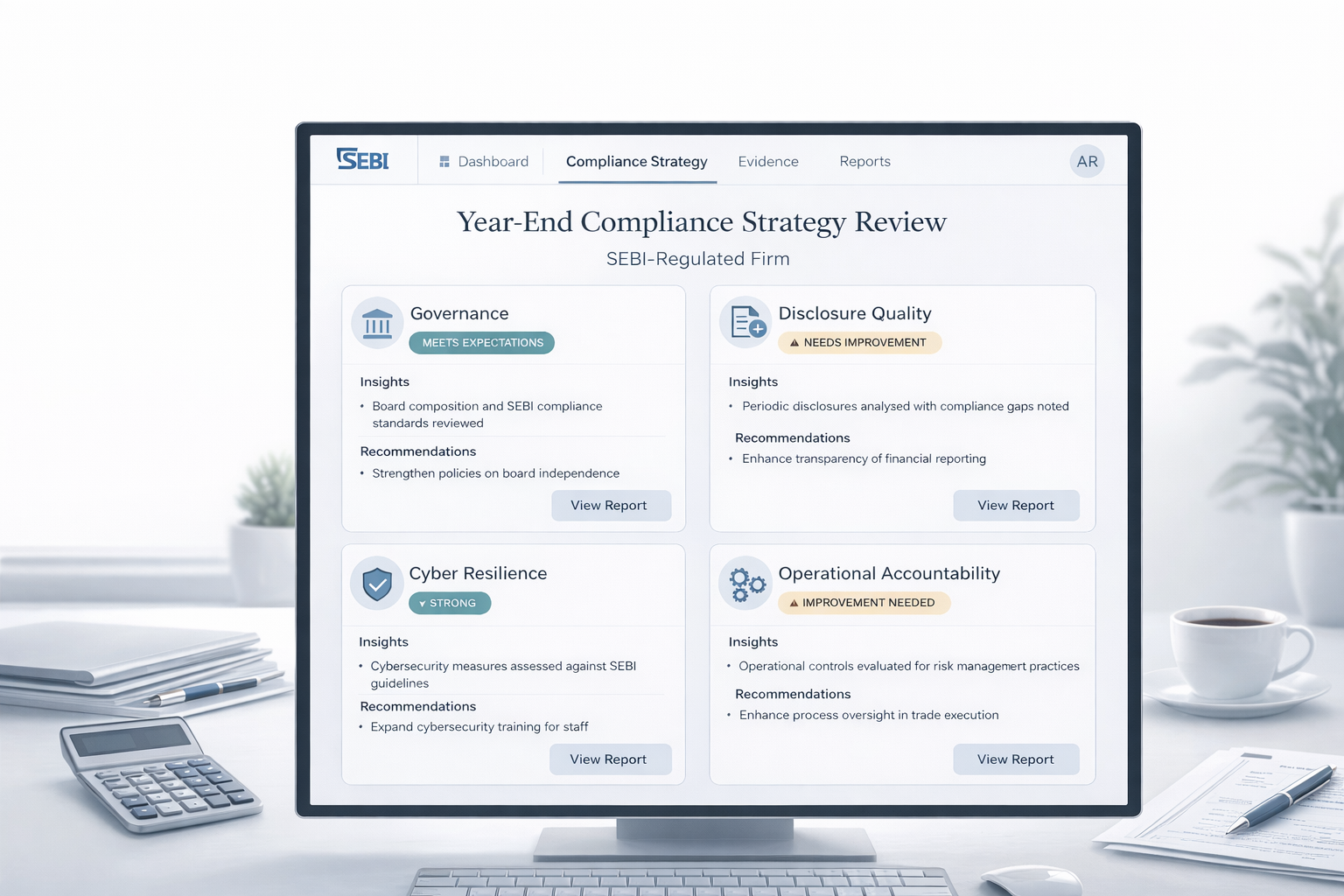
Going into 2025, firms should prepare for a sharper SEBI compliance environment shaped by governance quality, better disclosure discipline, stronger cyber expectations, and clearer operational accountability. The question is no longer just whether teams monitor updates, but whether they can prove controlled response.
- sebi compliance
- 2025 compliance themes
- corporate governance
- disclosure quality
- cyber resilience
- operational accountability
As one year closes and the next begins, compliance teams usually ask the same question: what should we be preparing for now, before the pressure arrives later?
That is the right question for December. Not “what dramatic surprise is coming next,” and not fake prediction for its own sake. The better question is what direction the regulatory environment is already pointing toward, and what that means for internal readiness.
Going into 2025, four themes stand out clearly in the SEBI environment: governance quality, disclosure discipline, cyber expectations, and operational accountability. This is not about claiming that every new requirement has already arrived in final form. It is about recognizing where regulatory attention has been moving, and where firms would be unwise to stay casual. SEBI’s 2024 cyber resilience framework for regulated entities, the year-end clarifications to that framework, and 2024 changes and proposals around disclosure formats and listed-entity governance all point in the same direction: less tolerance for loose processes, and more emphasis on structured, demonstrable control.
The first theme is governance quality.
For many firms, governance is still discussed at a high level, almost as a boardroom principle rather than an operating discipline. That mindset is becoming harder to defend. Recent SEBI materials on corporate governance and listed-entity requirements show continued attention to how governance norms are structured, applied, and disclosed. Even where some changes are framed through ease-of-doing-business language, the underlying message is not deregulation in the loose sense. It is cleaner architecture, clearer expectations, and more standardized compliance behavior.
What does that mean in practice? It means firms should prepare for governance to be judged less by policy language alone and more by whether decision-making, oversight, committee functioning, and escalation discipline actually work in a reviewable way. A board-approved framework that sits on paper is not enough. Teams should expect greater scrutiny on whether governance structures are translating into timely internal action.
The second theme is disclosure quality.
This is bigger than disclosure volume. Many firms already disclose a lot. The real issue is whether disclosures are timely, structured, comparable, and reliable. SEBI’s 2024 moves around XBRL-based disclosures and related listed-entity reporting changes point toward a continued push for more standardized and machine-readable disclosure architecture. That matters because standardization is not just a formatting exercise. It reduces ambiguity, improves comparability, and makes weak disclosure practices easier to spot.
The same pattern appears in sustainability and non-financial reporting discussions as well. SEBI materials around BRSR changes in 2024 show an ongoing effort to refine how disclosures are framed, assessed, and relied upon. Firms should not read that as a narrow ESG issue only. The broader lesson is that disclosure is being treated as something that must be supportable, not decorative.
For compliance teams, that creates a practical 2025 preparation point: stop thinking of disclosures as an end-stage filing exercise. Disclosure quality starts upstream. It depends on internal data discipline, review ownership, timeline control, and the ability to defend the basis of what was disclosed.
The third theme is cyber expectations.
Here the signal is especially strong. SEBI issued its Cybersecurity and Cyber Resilience Framework for regulated entities in August 2024, explicitly stating that the framework aims to strengthen cyber resilience and maintain robust cybersecurity across SEBI-regulated entities, and that it supersedes earlier cyber instructions listed in the framework. SEBI then issued clarifications in December 2024, which is usually a sign that implementation is meant to be taken seriously, not casually admired from a distance.
The important mistake to avoid here is treating cyber as an IT department topic. That would be too narrow. In the SEBI environment, cyber increasingly sits inside operational trust, business continuity, vendor dependence, auditability, and management accountability. Firms going into 2025 should assume that cyber expectations are no longer satisfied by broad policy statements alone. Regulators increasingly expect evidence of controls, testing, governance, reporting discipline, and implementation maturity. The compliance implication is obvious: cyber readiness can no longer sit outside the compliance conversation.
The fourth theme is operational accountability.
This is where the other three themes meet. Governance can be written down. Disclosures can be filed. Cyber frameworks can be adopted. But the real test is whether firms can show who reviewed what, who decided what, who implemented what, and how the response can be evidenced later.
That is why operational accountability is the theme many firms still underestimate. The pressure is not only on having policies. It is on showing controlled execution. Structured disclosure timelines, clearer reporting formats, cyber audit expectations, and formal governance architecture all push in the same direction: the regulator increasingly cares about whether firms can run disciplined internal processes, not merely whether they can produce documents after the fact.
For 2025 preparation, this means firms should look hard at their internal workflow. When a regulatory update comes in, is applicability decided clearly? Is ownership assigned? Are deadlines tracked? Is implementation evidenced? Can the firm retrieve that record later without reconstructing history from email threads and spreadsheets? If the answer is no, then the issue is not lack of intelligence. It is lack of operational control.
That is the real year-end takeaway.
The firms that will handle 2025 better are not necessarily the ones with the largest compliance teams or the longest policy manuals. They will be the ones that understand the direction early. Governance quality will matter more. Disclosure quality will matter more. Cyber expectations will remain serious. And operational accountability will increasingly separate firms that look compliant from firms that can actually prove control. That is the preparation lens worth carrying into the new year.
Related compliance hubs
Continue from this explainer into topic hubs that connect analysis with regulator updates and workflow context.
Related regulator archives
Continue into source-linked archives for regulators connected to this topic area.
Related articles
Continue with related analysis selected by the editorial team or sharing the same topics.
Related legal updates
Source-linked updates that place this article in the current regulatory workflow.
Content accountability
Prepared by CompliSense Editorial Desk (Regulatory Content Team).
This attribution reflects the preparation role used for CompliSense regulatory publishing.