Reducing Compliance Dependency on One Employee’s Memory
Many compliance processes look stable until one key employee goes on leave, resigns, or simply forgets a detail. Structured logging, ownership, and searchable records reduce key-person risk and make compliance operations more durable.
- key-person risk
- compliance operations
- regulatory monitoring
- institutional knowledge
- handover risk
- compliance workflow
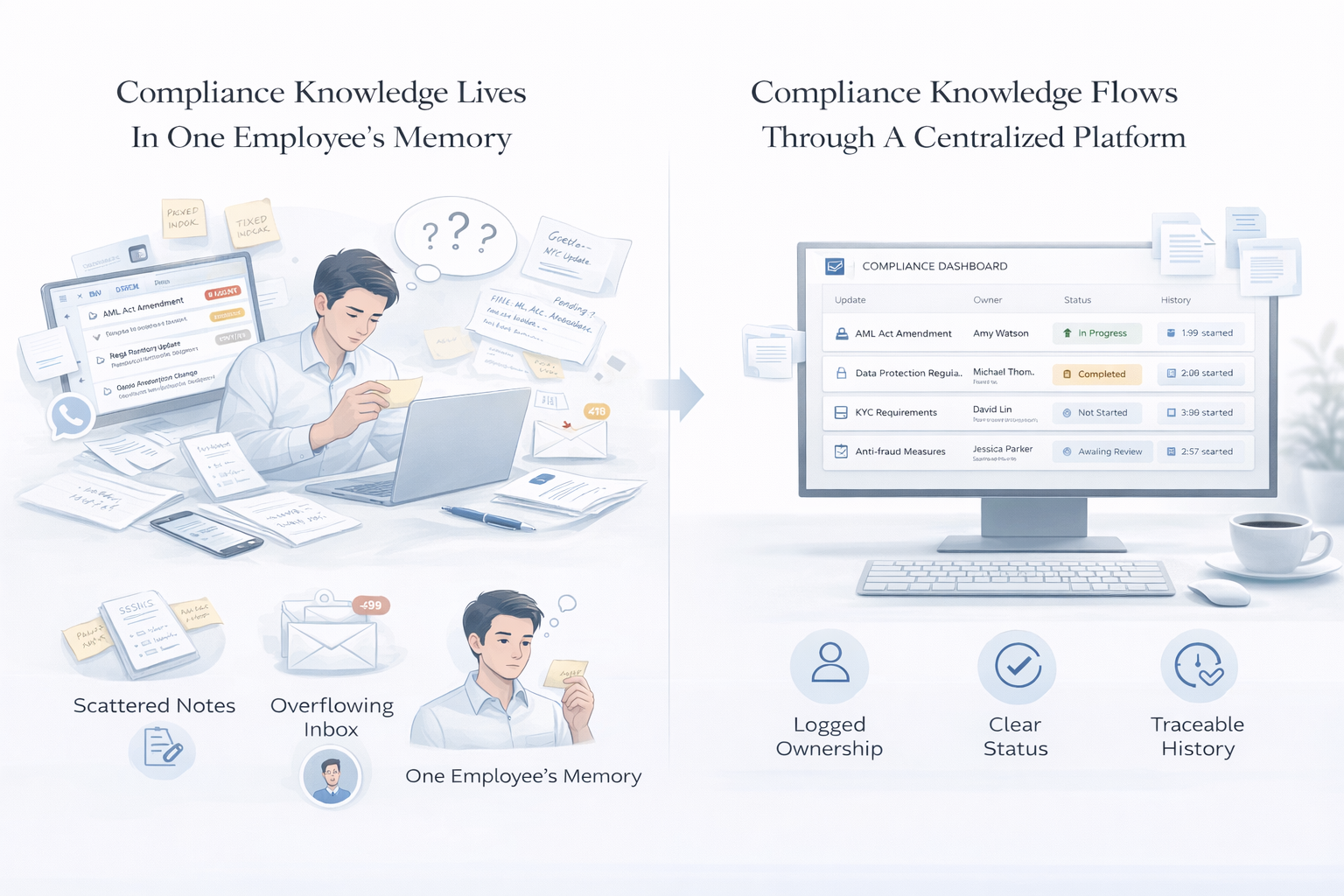
A lot of compliance processes look stronger than they really are.
On normal days, things appear under control. The right person knows which circulars matter. They remember which update was marked not applicable. They know which team was supposed to act, which item is still pending, and where the supporting email or file probably sits. Because that person is competent, responsive, and experienced, the process feels stable.
Then that person goes on leave.
Or resigns.- Or moves to another role.
- Or simply becomes overloaded.
That is when many firms discover that what looked like a compliance system was actually one employee’s memory holding the system together.
This is one of the most common and least openly discussed operational weaknesses in compliance teams. It does not usually show up in a dashboard. It does not always look dramatic from the outside. But it creates serious fragility. When too much knowledge sits inside one person’s head, the firm is not running a durable process. It is running a person-dependent workaround.
The first problem this creates is key-person risk. If one employee is the main holder of regulatory context, the team becomes dependent on that individual for continuity. They know which updates were important, which were routine, which were escalated, and which were closed informally. That may work while they are available. But once they are absent, the gap becomes obvious. The firm is left trying to reconstruct decisions, status, and reasoning from fragments.
The second problem is handover failure. Most handovers are weaker than firms like to admit. The outgoing person may share a few notes, mention some pending matters, forward a few threads, and explain the rest verbally. That feels like a handover, but it is often just compressed memory transfer. Important details get missed. Context is lost. Old assumptions are not questioned. The incoming person inherits work, but not always the logic behind the work. If the underlying workflow is not structured, handover becomes dependent on how much the previous employee happened to remember and communicate.
The third problem is leave and attrition risk. This is not only about resignation. Even short absence can expose a weak setup. If someone is on leave and the team cannot confidently answer what came in, what applies, who owns it, and what is pending, that is already a control problem. A process should not need its main human memory unit to remain continuously present in order to function.
The fourth problem is oral workflow dependence. Many compliance processes are still held together by conversations. “I told operations about that.” “We discussed this last week.” “He said it was not applicable.” “I think the evidence is saved somewhere.” These are not minor weaknesses. They are exactly how institutional knowledge becomes fragile. Oral workflows create the illusion of coordination while leaving behind weak records. They work until someone asks for proof, context, or continuity.
This is why reducing dependency on memory is not just an HR issue. It is a compliance control issue.
A stronger process starts with structured logging. Every regulatory update should leave a clear record in one place. That record should show the source, regulator, date and time captured, summary, applicability decision, owner, status, due date, and evidence. Once this information is recorded consistently, the firm no longer depends on one employee to “remember what happened.” The system itself begins to carry the history.
This matters especially for applicability decisions. One of the easiest things to lose in memory-driven workflows is the reasoning behind why an update was treated a certain way. Someone may remember that a circular was considered not applicable, but not remember why. Months later, that gap creates confusion. A structured log preserves the conclusion and the basis behind it. That reduces repeat debate and makes future review far easier.
The next step is clear ownership. Many fragile processes suffer from shared visibility but weak accountability. Several people may be aware of an update, but nobody is formally assigned. In memory-based environments, teams often rely on the assumption that “the usual person” is handling it. That is dangerous. A proper system should show exactly who owns the next step, what they are expected to do, and by when. Ownership reduces dependence on informal understanding.
Then comes searchable history. This is where institutional resilience starts improving materially. A good process should allow the team to retrieve past updates, see who reviewed them, understand the applicability decision, check the implementation path, and locate supporting evidence without hunting through inboxes or asking around. Searchability turns scattered knowledge into institutional memory. That is one of the clearest signs of a mature compliance operation.
It also improves supervision. When knowledge is trapped inside a few people, managers often rely on verbal updates and reconstructed summaries. That makes real oversight difficult. A structured system gives supervisors direct visibility into pending items, overdue actions, ownership patterns, and closure evidence. It allows management to oversee the process itself rather than depend on whoever currently remembers the most.
Most importantly, this reduces fragility during change. New joiners can get up to speed faster. Handovers become cleaner. Temporary absence becomes less disruptive. Teams become less dependent on personalities and more dependent on process. That is what firms should want. The goal is not to remove human judgment from compliance. The goal is to stop letting memory act as the hidden infrastructure.
Because memory is not a reliable system.
It is inconsistent. It is hard to audit. It does not scale well. And it weakens exactly when pressure rises.
Firms that want stronger compliance continuity should ask a simple question: if one key employee were unavailable tomorrow, how much of the real workflow would still be visible and usable? Could the team still identify what came in, what mattered, who owns it, what is pending, and where evidence sits? Or would they need calls, inbox digging, and guesswork to rebuild the picture?
That answer reveals a lot.
The real fix is not just better handover discipline. It is building a compliance process where decisions, ownership, progress, and proof are logged in a structured way from the start. That is how knowledge stops living inside one person and starts becoming part of the institution.
Related compliance hubs
Continue from this explainer into topic hubs that connect analysis with regulator updates and workflow context.
Related regulator archives
Continue into source-linked archives for regulators connected to this topic area.
Related articles
Continue with related analysis selected by the editorial team or sharing the same topics.
Related legal updates
Source-linked updates that place this article in the current regulatory workflow.
Content accountability
Prepared by CompliSense Editorial Desk (Regulatory Content Team).
This attribution reflects the preparation role used for CompliSense regulatory publishing.