NSE Review, Appeal, and Waiver Pathways: What Members Should Understand Before a Penalty Dispute
NSE’s revised review, appeal, and waiver pathway makes penalty disputes more process-driven. Members need strong timelines, evidence, internal sign-offs, and clean submissions before challenging an action.
- nse penalty
- review appeal waiver
- trading member compliance
- exchange inspection
- penalty dispute
- documentary evidence
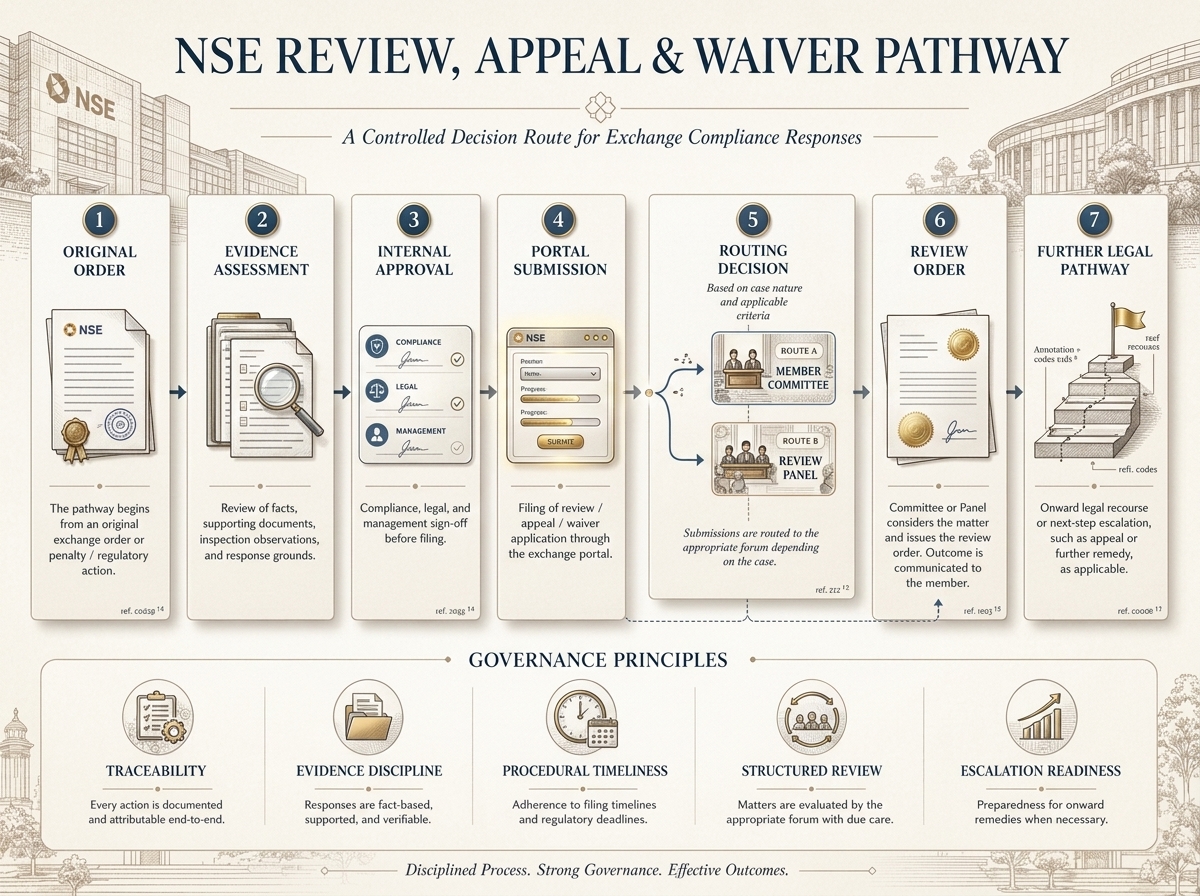
A penalty dispute does not begin when the review request is filed.
It begins on the day the Original Order or Original Action Letter is received.
That is the practical lesson members should take from NSE’s revised review, appeal, and waiver pathway. The process is not only about whether a member disagrees with a penalty. It is about whether the member can present its position within time, with the right evidence, through the right channel, and with a clear internal record.
For trading members and clearing members, this matters because penalty disputes often fail before the merits are properly considered. Not because the member has no argument. But because the explanation is late, incomplete, unsupported, or internally inconsistent.
The first point is timeline discipline.
NSE’s October 2025 circular sets a clear operating expectation: review, appeal, or waiver requests must be filed within the specified 45-day window from the Original Order or Original Action Letter. A member should not treat that as a soft administrative date. Once the order arrives, the clock has started.
This means the compliance team needs an internal trigger. The order should be logged immediately. The due date should be calculated on the same day. The responsible owner should be assigned. Supporting departments should be informed. Evidence collection should begin before the team decides whether to challenge the matter.
Waiting until the last week is risky because penalty disputes often require records from multiple teams. Inspection observations may involve compliance, operations, RMS, client onboarding, surveillance, DP operations, finance, IT, branch teams, or senior management. If the evidence has to be collected from many places, delay becomes expensive.
The second point is evidence discipline.
A review request is not a place for general explanations. It should be supported by complete documentary evidence. That phrase is important.
Members should assume that unsupported statements will carry limited value. If the member says a report was submitted, there should be submission proof. If the member says a process was followed, there should be SOPs, logs, screenshots, maker-checker records, branch confirmations, system reports, or audit trails. If the member says a delay was caused by a technical issue, there should be system evidence, vendor communication, incident record, and closure note.
A good penalty response file should have a simple structure:
Original action letter.
Relevant observation or violation.
Member’s explanation.
Documentary evidence.
Chronology of events.
Internal responsibility note.
Corrective action taken, if any.
Reason for review, appeal, or waiver.
Final authorised submission.
This structure helps the member avoid a common mistake: sending a long narrative without proving the facts.
The third point is choosing the correct ground.
Not every disagreement is the same. Sometimes the member believes the penalty is factually incorrect. Sometimes the member accepts the observation but seeks waiver or reduction because of mitigating circumstances. Sometimes there is evidence that the relevant compliance was completed but not properly considered. Sometimes there was a procedural gap, ambiguity, system issue, or exceptional circumstance.
The review strategy should match the ground.
A factual challenge needs factual proof. A waiver request needs mitigation and corrective action. A proportionality argument needs context. A process argument needs chronology. A repeat-violation issue needs stronger remediation evidence.
Members should not use a generic template for every penalty dispute. The submission should be built around the actual reason why the penalty should be reviewed, appealed, or waived.
The fourth point is internal sign-off.
A penalty dispute should not be filed only by the compliance officer in isolation. The relevant business or operational owner should confirm the facts. Legal should review the framing where the amount, precedent, or regulatory consequence is material. Senior management should be aware where the matter is significant, repeated, or reputationally sensitive.
This is not bureaucracy. It is protection.
If the member files a response based on incomplete internal confirmation, it may later discover that the facts were not exactly as presented. That is worse than not filing at all. A weak or inaccurate submission can damage credibility.
Before filing, the member should ask:
Have the facts been confirmed by the process owner?
Has all evidence been attached?
Has the chronology been checked?
Has the proposed ground been approved?
Has corrective action been documented?
Has an authorised person approved submission?
The fifth point is portal readiness.
NSE’s process requires members to use the member portal route for review requests relating to inspection observations. That means the compliance team should not wait until the filing day to understand the portal steps, case ID selection, violation-level submission, attachment format, and status tracking.
Operationally, this matters because portal submissions can fail for simple reasons: wrong case ID, incomplete attachment, unclear comment, missing document, file-size issue, or last-minute access problem.
A member preparing a serious review should maintain a submission checklist. It should show the case ID, violation selected, ground chosen, submission text, documents attached, authorised personnel details, filing date, payment of processing fee where applicable, acknowledgement proof, and later status updates.
The sixth point is understanding routing.
The revised pathway distinguishes between matters that continue before the Member Committee and matters arising from Member Committee actions that may be handled through the Review Panel mechanism set up by the Governing Board. Members do not need to overcomplicate this internally, but they do need to understand that the forum may depend on the source of the action.
The practical question is: who took the original action?
Was it an Exchange action under a pre-approved policy or structure?
Was it an action of the Member Committee?
Was the relevant Member Committee meeting after the implementation cut-off?
Does the matter go to the Member Committee or Review Panel?
This helps the member understand the process, expected review level, and internal escalation needed.
The seventh point is corrective action.
A penalty dispute should not only argue the past. It should also show what has been fixed.
If the member has already corrected the process, updated controls, trained staff, changed system logic, enhanced maker-checker review, or implemented a new monitoring mechanism, that should be documented. Corrective action does not automatically remove the penalty, but it strengthens the member’s credibility.
A good corrective action note should not sound defensive. It should be specific: what failed, what was changed, when it was changed, who owns the new control, and what evidence proves implementation.
The eighth point is preserving the full dispute trail.
Even after filing, the member should maintain a clean record. The file should contain the original order, internal emails, evidence pack, submission copy, portal acknowledgement, fee proof, review order or review action letter, and any later legal advice or further appeal decision.
This becomes important if the member later approaches another authority or needs to explain the matter during inspection, audit, management review, or board reporting.
The deeper lesson is that penalty disputes are not won by memory. They are managed by process.
Members should not wait for a penalty to design the response mechanism. The mechanism should already exist. Every action letter should enter a controlled workflow: log the order, calculate the deadline, identify the issue, collect evidence, decide strategy, obtain sign-off, file through the correct route, track status, and preserve outcome.
This is especially important for repeated or high-volume inspection observations. If every penalty response is handled manually from scratch, the member will eventually miss a deadline, attach weak evidence, or file an inconsistent explanation.
The firms that handle review, appeal, and waiver requests well usually have one advantage: they treat the dispute as a compliance project, not a one-time letter.
That is the standard members should move towards.
Related compliance hubs
Continue from this explainer into topic hubs that connect analysis with regulator updates and workflow context.
Related regulator archives
Continue into source-linked archives for regulators connected to this topic area.
Related compliance hub
Continue with broker-focused regulatory sources, workflow context, and selected evidence.
Related articles
Continue with related analysis selected by the editorial team or sharing the same topics.
Related legal updates
Source-linked updates that place this article in the current regulatory workflow.
Content accountability
Prepared by CompliSense Editorial Desk (Regulatory Content Team) and reviewed by CompliSense Regulatory Review Desk (Compliance Review Team).
This attribution reflects the preparation and review roles used for CompliSense regulatory publishing.